

The Supreme Court ruling on the International Emergency Economic Powers Act in early 2026 marked a pivotal moment in U.S. constitutional law, curbing expansive presidential authority over economic emergencies. This decision addressed challenges to tariffs imposed by President Donald Trump, clarifying boundaries on executive power under the IEEPA.
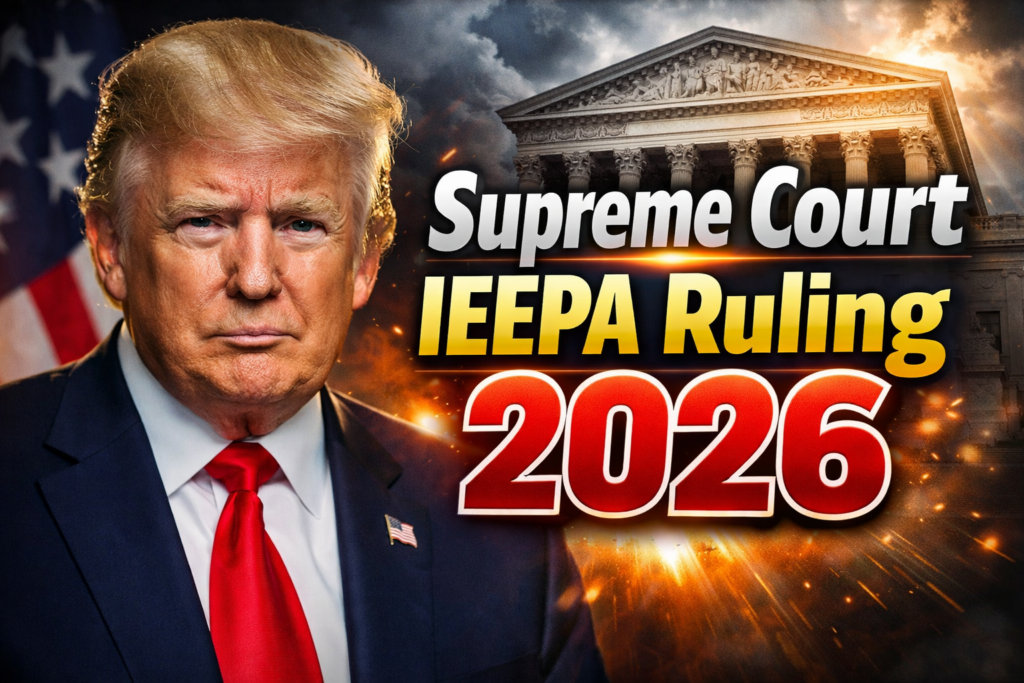
Introduction to the Ruling
The Supreme Court’s decision came after months of intense legal battles over the president’s use of the IEEPA to declare national emergencies and impose sweeping tariffs on imports from multiple countries. Challengers, including importers and trade groups, argued that this stretched the law beyond its intent, encroaching on Congress’s constitutional role in regulating commerce and levying duties. The Court, in a closely divided opinion, sided largely with the challengers, ruling that while the IEEPA grants significant emergency powers, it does not authorize broad, indefinite tariffs without explicit congressional approval.
This outcome stemmed from oral arguments heard in late 2025, where justices expressed skepticism about unlimited executive discretion. Lower courts, including the Court of International Trade, had already invalidated key aspects of the tariffs, setting the stage for the high court’s intervention. The ruling emphasized judicial review of emergency declarations, ensuring they meet statutory criteria like addressing unusual and extraordinary foreign threats.
Background on IEEPA
The International Emergency Economic Powers Act, enacted in 1977, emerged as a response to concerns over unchecked presidential authority under its predecessor, the Trading with the Enemy Act. Designed to provide tools for handling international crises, IEEPA allows the president to declare a national emergency upon finding an “unusual and extraordinary threat” originating substantially from abroad. Once declared, the executive can regulate international economic transactions, including freezing assets, blocking property, and imposing sanctions.
Historically, presidents have invoked IEEPA over 70 times for sanctions against nations like Iran, Russia, and Venezuela, focusing on targeted measures rather than widespread trade barriers. President Trump expanded its use dramatically in early 2025, declaring emergencies tied to narcotics flows, migration, and trade imbalances. This led to tariffs on goods from China, Mexico, Canada, and dozens of other countries, ranging from 10 percent universally to as high as 41 percent on specific nations.
The Tariff Impositions Leading to the Case
In February 2025, executive orders under IEEPA targeted imports from key trading partners, citing border security and fentanyl crises as national emergencies. China faced layered duties due to prior trade tensions, while Mexico and Canada saw initial 25 percent tariffs, later adjusted. By April, reciprocal tariffs extended to most countries, aiming to mirror foreign duties on U.S. exports and reduce trade deficits.
These measures generated substantial revenue, with customs collections from IEEPA tariffs reaching over 130 billion dollars by late 2025, accounting for a significant portion of total duties. Importers, from retailers to manufacturers, absorbed higher costs, passing them to consumers through elevated prices. Economic analyses showed price levels rising across sectors, with average households facing annual losses in purchasing power.
| Country/Region | Tariff Rate Range | Key Affected Industries | Estimated Annual Import Value Impacted |
|---|---|---|---|
| China | 25-41% | Electronics, machinery, consumer goods | Hundreds of billions |
| Mexico/Canada | 10-25% | Autos, agriculture, energy | Over 500 billion combined |
| Other Countries (e.g., Japan, EU) | 10-20% | Machinery, vehicles, chemicals | Trillions in global trade |
| Venezuela Oil Importers (e.g., India, Spain) | Up to 25% | Energy products | Billions in secondary effects |
This table illustrates the broad scope, affecting virtually all import sectors except exemptions like pharmaceuticals and certain agriculture.
Legal Challenges and Path to Supreme Court
Over 90 lawsuits flooded the Court of International Trade by mid-2025, with plaintiffs arguing IEEPA lacked language authorizing tariffs, a tool reserved for Congress under Article I. The court ruled in May that the law provided no “unbounded authority” for such duties, invoking the major questions doctrine requiring clear statutory backing for economically significant actions. Appeals courts upheld this, rejecting claims of non-justiciable political questions.
The government defended by asserting inherent Article II foreign affairs powers, amplified by IEEPA’s broad delegation. They argued emergencies like drug trafficking met the four statutory prongs: unusual threat, foreign origin, formal declaration, and targeted response. Importers sought refunds for duties paid, posting billions in customs bonds.
The Supreme Court consolidated cases for expedited review, hearing three hours of arguments in November 2025. Justices probed statutory text, historical use, and constitutional limits, with many voicing concerns over executive overreach.
Key Arguments in the Case
Challengers highlighted IEEPA’s purpose to constrain, not expand, powers post-Vietnam era. They noted no prior president used it for tariffs, and “regulate importation” implied narrow controls, not tax-like duties. The nondelegation and major questions doctrines loomed large, as unbounded authority would let the executive rewrite trade policy unilaterally.
The administration countered that IEEPA’s sweeping language covered tariffs as economic regulation during crises. They stressed deference in foreign affairs, with congressional oversight via termination resolutions. Oral arguments revealed justices wary of erasing guardrails, questioning if trade deficits qualified as “extraordinary threats.”
The Supreme Court Decision Explained
In its February 2026 ruling, the Court held that IEEPA authorizes economic measures during true emergencies but not broad tariffs resembling taxes. A 5-4 majority found the impositions exceeded statutory bounds, lacking explicit tariff permission and failing major questions scrutiny. The president must demonstrate threats are foreign-sourced and not pretext for domestic policy.
The decision mandated refunds for affected importers, potentially totaling tens of billions, via administrative protests or residual jurisdiction suits. It preserved IEEPA for sanctions but required stricter judicial oversight of declarations. Dissenters argued for maximal executive flexibility in crises, warning of hampered national security responses.
Implications for Presidential Powers
This ruling reins in emergency powers, signaling courts will scrutinize IEEPA invocations more rigorously. Presidents can no longer use it as a tariff shortcut, pushing trade actions back to Congress or specific statutes like Section 232. It bolsters separation of powers, affirming Congress’s commerce clause primacy.
Future emergencies, like cyber threats or energy sanctions, remain viable if narrowly tailored. The decision may inspire challenges to longstanding IEEPA uses, prompting legislative reforms for clearer limits.
Economic and Global Trade Effects
Tariffs slowed GDP growth, raised unemployment by several tenths of a percent, and shrank output in construction and agriculture while boosting manufacturing marginally. Price hikes hit average households hard, with broader economy persistently smaller without the duties.
Globally, allies like Canada and the EU faced disrupted supply chains, while China saw amplified tensions. Refunds could ease importer burdens, lowering bond requirements and stabilizing prices. Markets reacted with volatility, but long-term clarity benefits trade predictability.
| Economic Metric | Pre-Tariff Baseline | With IEEPA Tariffs | Post-Ruling Projection |
|---|---|---|---|
| Average Effective Tariff Rate | Around 2% | Up to 15% | Reverts toward 5-7% |
| Annual Household Cost | N/A | 1,700 dollars loss | Partial recovery |
| GDP Impact (Long-Run) | Steady | 0.3% smaller | Minimal drag |
| Tariff Revenue (2025) | Standard duties | 168 billion extra | Refunds strain budget |
Broader Constitutional Ramifications
The ruling revives nondelegation concerns, potentially curbing other broad statutes. It aligns with recent major questions applications, demanding precise congressional intent for big economic moves. For President Trump, it limits Agenda 47 trade goals, forcing congressional buy-in.
Scholars hail it as restoring balance, preventing “emergency” as a bypass for legislation. Critics fear it ties executive hands in fluid threats.
Future Outlook and Policy Recommendations
Congress may amend IEEPA for explicit tariff options or time limits on emergencies. Importers should file protests promptly for refunds, while businesses diversify supply chains. Globally, it encourages multilateral trade pacts over unilateral actions.

Abhinav Jain is a legal researcher and writer passionate about simplifying complex laws for everyday readers. With a keen interest in Indian constitutional, civil, and digital laws, he focuses on creating accessible, well-researched articles that promote legal awareness among students, professionals, and citizens alike.