
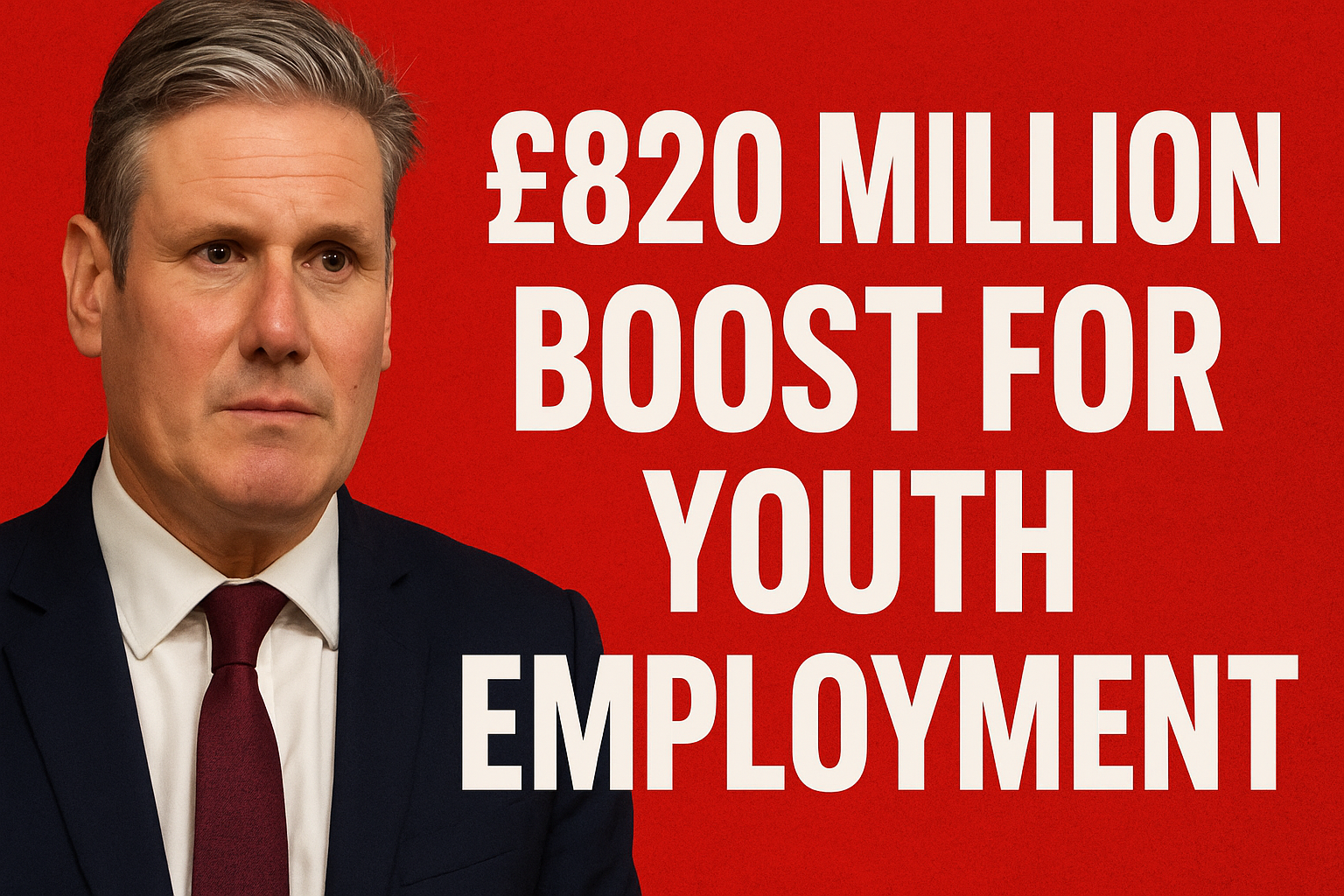
£820 million in new funding will create 350,000 work and training places for young people on benefits, forming the core of a UK-wide push to cut the NEET rate and tackle long-term youth unemployment. This package is expected to support close to one million young people through a mix of short training, work experience and guaranteed job opportunities across high-demand sectors.

Overview of the £820 million youth employment package
The government has launched an £820 million investment focused on young people who are not in education, employment or training, often referred to as NEET. The plan combines training, work placements and subsidised jobs to help young claimants move off welfare and into sustainable work.
This new funding will sit alongside existing support in Jobcentres and Youth Hubs, but is targeted more aggressively at the NEET crisis that has left close to one million young people without a foothold in work or education.
What the 350,000 new places will offer
The package will fund 350,000 new training and work experience opportunities, primarily for young Universal Credit claimants aged 18 to 24. Many of these places will be concentrated in sectors such as construction, health and social care and hospitality, where employers report significant skills shortages and vacancies.
Participants are expected to get a blend of six weeks of training, on-the-job experience and structured employability support including CV preparation and interview coaching, followed by a guaranteed job interview. In high-need areas, this will be backed up by a wage-subsidy model that creates fully funded, time‑limited jobs for thousands of young people.
The NEET crisis: scale of the challenge
The NEET problem in the UK remains stubbornly high, with recent estimates showing around 946,000 to 948,000 16–24‑year‑olds not in education, employment or training in mid‑2025. That equates to roughly 12.7 to 12.8 percent of the entire 16–24 population, with young men especially likely to be NEET.
While there have been small quarter‑to‑quarter shifts, the overall picture is of a persistently large group at risk of long-term scarring in earnings, health and wellbeing if they fail to connect to the labour market early. Policy makers increasingly link rising NEET numbers to ill health, disability and post‑pandemic disruption in education and training pathways.
Key statistics on youth NEETs and the new scheme
The table below summarises core statistics on the NEET challenge and the new youth employment package.
These figures highlight both the scale of the NEET crisis and the ambition of the government’s response, especially in combining training with concrete work opportunities.
How the scheme will work in practice
Under the new model, eligible young people on Universal Credit will be offered a structured six‑week pathway combining classroom‑style training with real‑world work experience. Training will focus on job‑specific skills, basic digital competence and core employability skills such as communication, teamwork and punctuality.
At the end of the placement, participants will typically receive a guaranteed job interview with the employer hosting their placement or another employer in the same sector. In areas with the highest youth unemployment, this will feed into subsidised jobs in which the government covers wage costs for a limited period to incentivise hiring young people who lack experience.
Priority sectors and regional targeting
The government plans to channel many of the 350,000 opportunities into sectors facing chronic labour shortages, such as construction, social care, and hospitality. These fields can offer rapid entry‑level roles and clear progression routes for young people with limited qualifications.
Regional targeting will prioritise local authorities and communities with the highest NEET rates and the weakest labour market conditions. Ministers have also promised to expand Youth Hubs to more than 360 sites across Great Britain so that every area has a dedicated space for young people to access careers advice, training options and employer connections.
Conditionality, sanctions and “no‑show” risks
A controversial element of the wider youth employment push is a tougher stance on conditionality and benefit sanctions for those who do not engage with offers of work or training. Ministers have signalled that young people who turn down reasonable job offers or fail to take up mandated placements could lose benefits unless they have a valid reason.
Supporters argue that this balance of rights and responsibilities is necessary to ensure public money translates into real labour market participation. Critics warn that strict sanctions could hit vulnerable young people with health issues, caring responsibilities or unstable housing, potentially pushing them deeper into poverty rather than closer to work.
Potential impact on employers and the wider economy
Employers in shortage sectors stand to gain from a stream of subsidised, pre‑screened young candidates who already have targeted training and initial work experience. For industries like construction and care that struggle with recruitment and retention, this could help plug gaps while improving diversity and age balance across their workforces.
At the macro level, a successful rollout would boost employment, increase tax receipts and reduce welfare spending over time, easing pressure on the public finances. Reducing youth NEET rates is also associated with better long‑term outcomes in health, crime and social cohesion, so the £820 million package can be viewed as both an economic and a social investment.
Challenges and questions about effectiveness
Despite the scale of investment, several questions remain about whether the scheme will deliver lasting change rather than short‑term improvements. Key challenges include ensuring that placements are of genuine quality, that training is aligned with local employer demand and that young people receive sustained support rather than a brief intervention.
There are also concerns about potential “revolving door” effects if young people move through a succession of short placements without progressing into stable, permanent jobs. Robust monitoring, local partnership working and feedback from participants will be essential to avoid cycling young people through low‑quality opportunities that do not improve their long‑term prospects.
What success could look like for the NEET crisis
If implemented effectively, the £820 million package could play a central role in bringing the NEET rate down from its current level of around 12.7 to 12.8 percent. Success would mean not just fewer young people on benefits, but more 18–24‑year‑olds in sustained employment or high‑quality education and training that leads to real careers.
Clear metrics might include a measurable fall in NEET numbers, high rates of transition from placements into permanent jobs, and improved earnings trajectories for former participants compared to similar young people who did not access the scheme. If these outcomes are achieved, the 350,000 new work and training places will represent a significant step toward tackling the UK’s NEET crisis and giving a generation a fairer start in working lif

Abhinav Jain is a legal researcher and writer passionate about simplifying complex laws for everyday readers. With a keen interest in Indian constitutional, civil, and digital laws, he focuses on creating accessible, well-researched articles that promote legal awareness among students, professionals, and citizens alike.