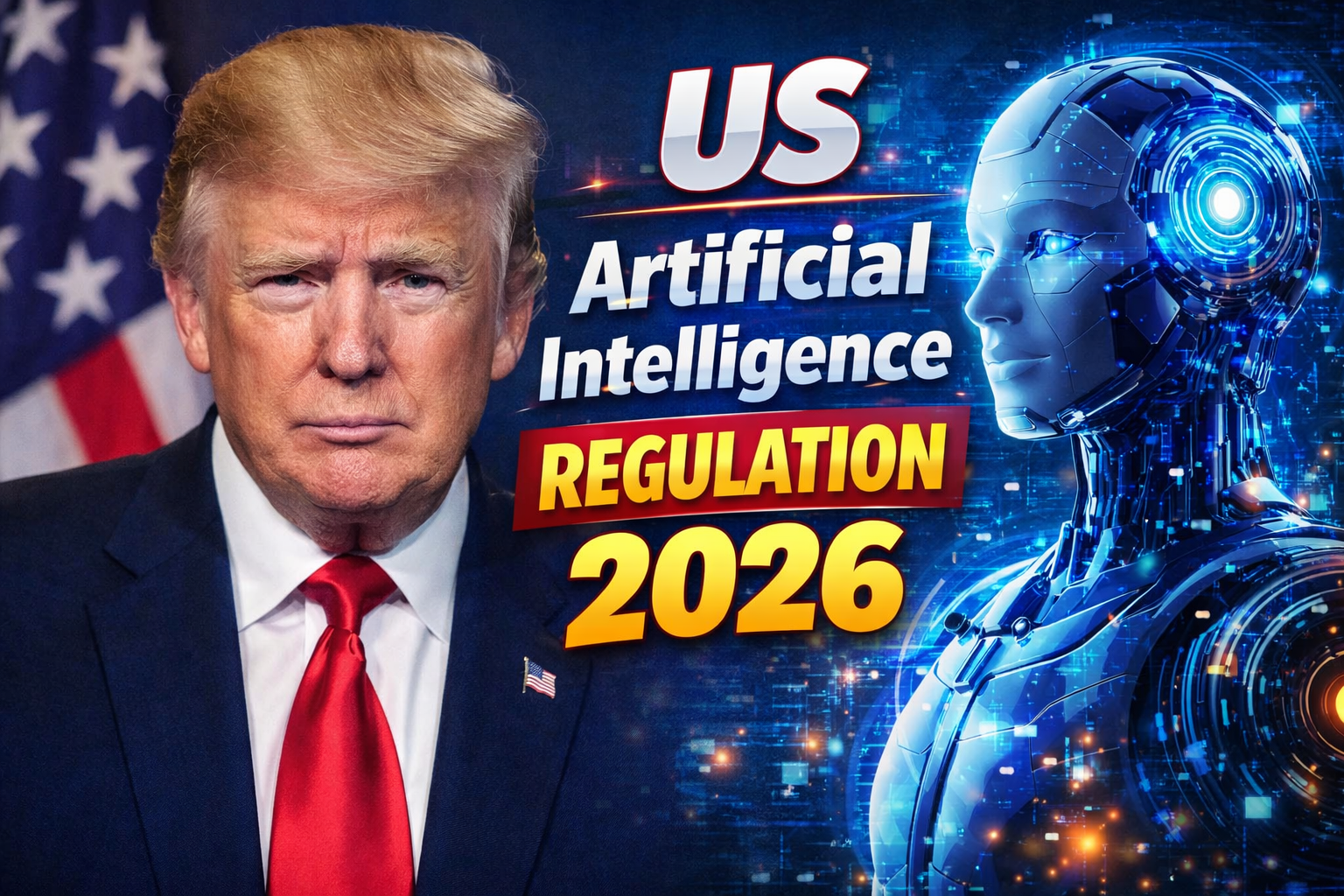
The landscape of artificial intelligence regulation in the United States has reached a critical juncture in 2026, marked by escalating tensions between federal ambitions for uniformity and aggressive state-level initiatives. President Trump’s administration has aggressively pursued a national framework to preempt patchwork rules, establishing a Department of Justice task force to challenge conflicting state laws while positioning America as the global leader in AI innovation.
Introduction
As AI technologies permeate every sector from healthcare to defense, the US faces a regulatory patchwork that threatens innovation and competitiveness. Federal efforts, spearheaded by a December 2025 executive order, aim to centralize oversight under a deregulatory ethos, emphasizing risk-based approaches over heavy-handed mandates. This push collides with states like California, Colorado, and Texas enacting their own AI-specific laws effective early 2026, creating uncertainty for developers and deployers alike. The DOJ’s AI Litigation Task Force emerges as a linchpin, poised to litigate preemption claims, while the broader strategy eyes international alignment to counter China’s advances. These developments signal a pivotal year where federal supremacy could reshape AI governance worldwide.
Federal AI Regulation Framework
The cornerstone of federal AI policy is the executive order “Ensuring a National Policy Framework for Artificial Intelligence,” signed by President Trump on December 11, 2025. This directive prioritizes innovation by directing agencies to eliminate barriers, foster infrastructure, and preempt state overreach.
Executive Order Directives
Key provisions mandate the Federal Trade Commission to issue a policy statement clarifying how existing antitrust and consumer protection laws apply to AI models, particularly those requiring alterations to “truthful outputs.” The Federal Communications Commission must explore a unified reporting standard for AI models, explicitly designed to override conflicting state requirements. Agencies are instructed to withhold federal funding, such as broadband grants, from states enforcing “onerous” AI rules, leveraging economic incentives for compliance.
Proposed Legislation
Building on the order, the administration backs the TRUMP AMERICA AI Act, a comprehensive bill imposing a duty of care on developers to mitigate foreseeable harms through risk assessments and reporting to the Department of Homeland Security. Frontier AI systems—those posing catastrophic risks—face enhanced protocols, including evaluation programs under the Department of Energy. This legislation largely preempts state laws on risk management for high-capability models, enforceable primarily by the FTC.
| Federal Initiative | Key Focus | Enforcement Mechanism |
|---|---|---|
| Executive Order 2025 | Preemption and uniformity | DOJ Task Force, agency policy statements |
| TRUMP AMERICA AI Act | Duty of care, frontier risks | FTC rulemaking, DHS reporting |
| FCC Proceeding | Model disclosure standards | Federal preemption of states |
| FTC Policy Statement | Deceptive practices in AI | Application of FTC Act |
These measures reflect a philosophy of minimal intervention, contrasting with Europe’s prescriptive model, and aim to keep US firms ahead in the global AI race.
State-Level AI Regulations
In the absence of comprehensive federal law, states have surged ahead, enacting over a dozen AI bills by early 2026. California leads with multiple measures, while Colorado and Texas target specific risks, igniting federal backlash.
California’s Multifaceted Approach
Effective January 1, 2026, California’s Generative AI Training Data Transparency Act requires developers of public-use generative models to disclose high-level training data summaries. The AI Transparency Act mandates labeling of AI-generated content, with steep penalties for noncompliance. The Trusted Frontier AI Accountability Act imposes safety obligations on frontier models, including impact assessments—directly cited in federal critiques for compelling output alterations.
Colorado and Texas Innovations
Colorado’s AI Act, delayed to June 30, 2026, demands “reasonable care” from high-risk AI deployers to prevent algorithmic discrimination, focusing on employment, housing, and lending. Texas’s Responsible AI Governance Act emphasizes ethical deployment in government use, requiring bias audits. Other states like New York and Illinois layer privacy-enhanced rules, creating a compliance nightmare for national firms.
| State Law | Effective Date | Core Requirements |
|---|---|---|
| California AB 2013 | Jan 1, 2026 | Training data disclosure |
| California SB 942 | Jan 1, 2026 | AI content labeling |
| Colorado SB 24-205 | Jun 30, 2026 | Anti-discrimination safeguards |
| Texas RAIGA | Jan 1, 2026 | Government AI audits |
These laws, while addressing legitimate harms, fragment the market, raising costs estimated at billions for multistate operators.
Federal vs State Rules: The Preemption Clash
The federal-state divide centers on preemption doctrine, with the executive order declaring many state rules unconstitutional burdens on interstate commerce. Federal policy targets laws mandating disclosures that could violate First Amendment protections or force AI censorship.
Points of Conflict
States requiring “truthful output” modifications, like Colorado’s discrimination mandates, face FTC preemption under deceptive practices prohibitions. Disclosure-heavy rules in California conflict with proposed FCC standards. The order exempts child safety and infrastructure permitting, allowing narrow state roles, but broadly challenges sector-specific interventions.
Economic and Innovation Impacts
Proponents argue state patchworks stifle startups, with compliance costs diverting resources from R&D. A unified federal approach promises scalability, vital as US AI investments hit record highs. Critics warn of a race to the bottom, potentially overlooking biases in hiring or lending.
This tension mirrors historical telecom battles, where federal supremacy prevailed, suggesting states may yield under litigation and funding pressures.
DOJ Litigation Task Force
Launched under the Attorney General’s authority, the AI Litigation Task Force represents the administration’s enforcement arm, tasked with dismantling noncompliant state laws.
Mandate and Operations
By March 11, 2026, the Secretary of Commerce must publish an evaluation flagging burdensome statutes for Task Force referral, prioritizing those altering model behaviors or imposing unconstitutional reporting. The group coordinates lawsuits alleging Commerce Clause violations, drawing on precedents like Lopez v. United States.
Early Actions and Projections
Initial targets include California’s TFAIA and Colorado’s Act, with suits anticipated by mid-2026. The Task Force collaborates with the FTC and FCC, amplifying legal firepower. Success could cascade, pressuring other states to align or face defunding.
| Task Force Priorities | Examples | Legal Basis |
|---|---|---|
| Output Alteration | Colorado AI Act | FTC Act preemption |
| Disclosure Mandates | California AB 2013 | First Amendment |
| Risk Assessments | Texas RAIGA | Interstate commerce |
This body underscores the administration’s commitment to federal primacy, potentially resolving the patchwork through judicial fiat.
Global Strategy in AI Regulation
The US positions AI policy as a national security imperative, integrating regulation with diplomacy to lead internationally while countering adversaries.
International Alignment Efforts
Federal strategy promotes US standards via trade agreements, urging allies to adopt light-touch models. The AI Action Plan coordinates with the Special Advisor for AI and Crypto to preempt foreign rules harming US exports. Exemptions for child safety facilitate G7/G20 harmonization.
Competition with China and EU
Against China’s state-driven AI dominance, the US emphasizes private-sector agility, using export controls on chips alongside deregulation. The EU’s AI Act, with its high-risk classifications, serves as a foil, highlighting American innovation over bureaucracy. Bilateral deals with the UK and Japan embed preemption principles.
| Global Comparison | US Approach | EU/China Contrast |
|---|---|---|
| Risk Framework | Voluntary, developer-led | Mandatory tiers |
| Preemption | Strong federal | National variations |
| Innovation Focus | Deregulatory | Compliance-heavy |
This outward gaze ensures US AI leadership, with mid-2026 legislative pushes aiming for treaty-backed uniformity.
Implications for Industry and Society
Businesses face a transitional 2026: prepare for federal baselines while monitoring Task Force suits. Developers should prioritize risk documentation to satisfy both levels. Ethically, the balance tilts toward speed over caution, demanding self-regulation.
For society, uniform rules promise equitable access but risk under-addressing biases. Globally, US victories could export standards, shaping a pro-innovation norm.
Challenges and Future Outlook
Litigation timelines stretch into 2027, prolonging uncertainty. Congressional gridlock may stall the TRUMP Act, forcing reliance on executive tools. States, backed by progressive coalitions, vow resistance, potentially escalating to Supreme Court review.
Yet momentum favors federalization, with economic stakes—trillions in AI value—driving consensus. By year’s end, expect clarified battle lines, setting precedents for decades.

Abhinav Jain is a legal researcher and writer passionate about simplifying complex laws for everyday readers. With a keen interest in Indian constitutional, civil, and digital laws, he focuses on creating accessible, well-researched articles that promote legal awareness among students, professionals, and citizens alike.