
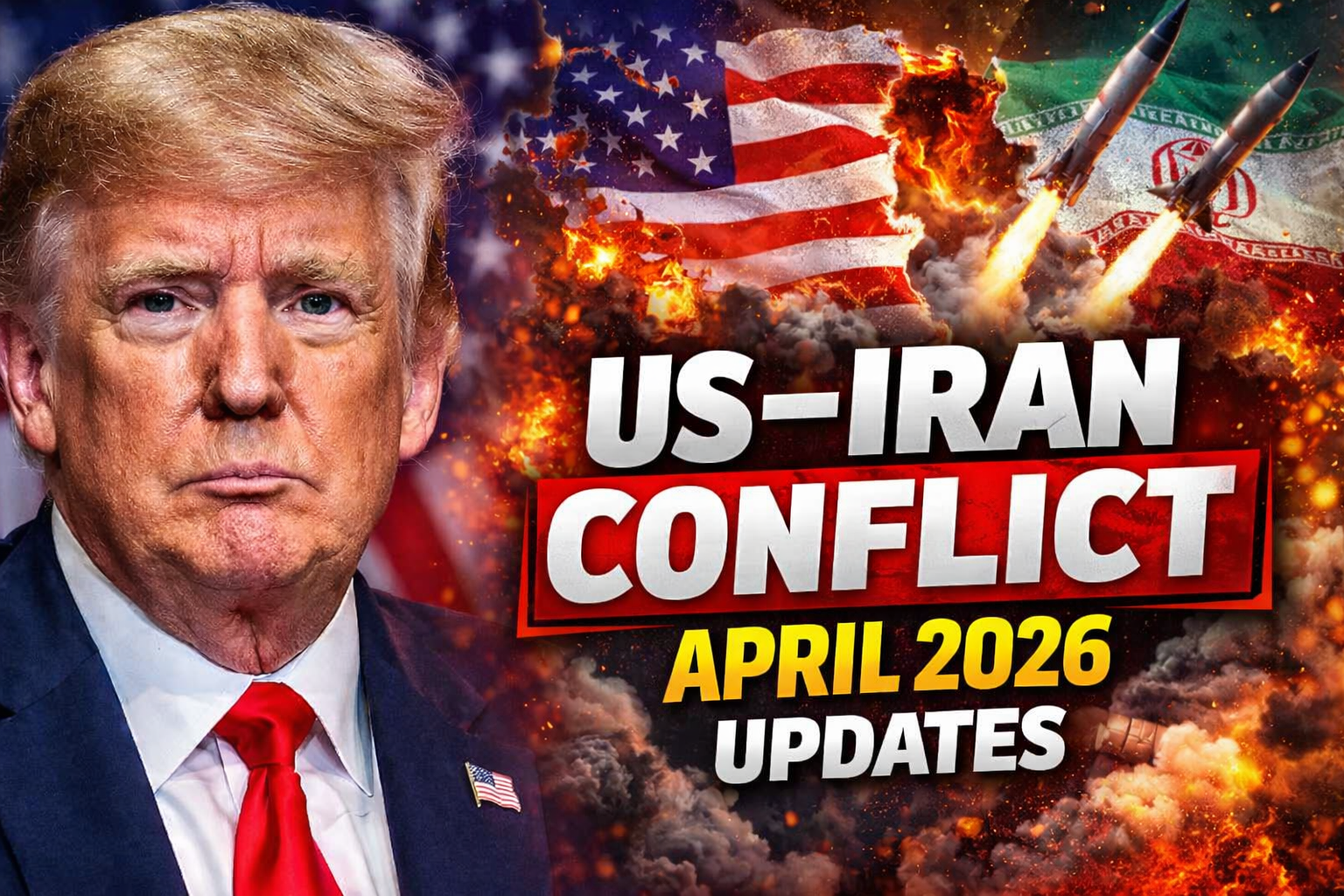
By early April 2026, the US–Iran war has hardened into a grinding, high‑stakes confrontation that pivots on one narrow stretch of water: the Strait of Hormuz. Once treated as a relatively stable maritime chokepoint, Hormuz now sits at the heart of a global crisis, with shipping paralyzed, energy markets swinging wildly, and regional stability hanging in the balance. At the same time, US President Donald Trump has escalated his rhetoric to its most aggressive point yet, threatening Iran with broad strikes against its civilian infrastructure unless the strait is immediately reopened. The combination of military pressure, economic disruption, and nuclear‑level rhetoric has turned April 2026 into a make‑or‑break window for the conflict—and for the global order that depends on free passage through the Gulf.
The Strait of Hormuz at a Standstill
The 2026 Strait of Hormuz crisis did not begin from a routine skirmish; it erupted from a sequence of direct US–Israel strikes on Iranian leadership and infrastructure, capped by the reported killing of Iran’s supreme leader, Ali Khamenei, in late February. Tehran’s response, coordinated by the Islamic Revolutionary Guard Corps (IRGC), was a swift and systematic closure of the strait. Iranian naval and missile units, backed by an array of drones and coastal defense batteries, declared the waterway “under Iranian control” and warned that any vessel attempting to transit without explicit permission would be targeted.
By early March, at least eight commercial ships had been damaged or struck by missiles and drones, with tankers like the Malta‑flagged Safeen Prestige forced to evacuate their crews after being hit. A US‑flagged vessel, the Stena Imperative, caught fire at Bahrain’s port, and a tugboat sent to assist the damaged Safeen Prestige was itself struck by missiles and sank, leaving sailors missing. Other vessels that tried to slip through—the Pola, the Prima, the US‑linked Louis P, and the Qatar‑linked Aqua 1—suffered hits, fires, or near‑misses, often under murky reporting and competing claims about who fired first.
The operational consequence was simple: for all practical purposes, the Strait of Hormuz stopped functioning as a commercial corridor. The usual stream of oil‑laden tankers, liquefied natural gas carriers, and container ships dried up, creating a bottleneck that quickly rippled into the global energy system. Insurance premiums for Gulf shipping spiked, re‑routing options grew scarce, and spot markets scrambled for alternative supplies, driving crude prices toward record highs. The IEA and several energy‑security experts warned that the longer the strait remains closed, the more the disruption will bleed into everything from gasoline pumps to power grids and food‑production chains.
The Energy Crisis Hits Hard
The Strait of Hormuz is no ordinary strait. It funnels roughly one‑fifth of the world’s seaborne oil and a significant share of LNG exports from the Gulf states to global markets. When the waterway shuts down, every economy that relies on Gulf‑sourced fuel feels the pinch. By April 2026, the crisis has already forced a wave of emergency measures across continents.
Several oil‑importing nations have activated rationing schemes, limiting fuel allocations for airlines, trucking companies, and even private vehicles to keep critical infrastructure running. Some governments are offering cash subsidies directly to households to offset the soaring cost of transportation and heating, while airlines are cutting nonessential routes and substituting long‑haul flights with regional hops. Ports in Europe and Asia report longer delays and higher storage costs, as alternative routes, including the Cape of Good Hope, add days and fuel expenses to transits.
Beyond oil, the closure is hitting a broader basket of commodities: LNG, petrochemicals, fertilizers, construction materials, and even certain food‑related feedstocks are now facing bottlenecks. Analysts count at least nine major commodity flows that have become unstable or rerouted, with knock‑on effects on inflation, trade balances, and political stability in import‑dependent countries. For Washington, this translates into a domestic political headache: voters in the US are already grappling with higher gas prices and transit costs, and the Strait‑driven spike threatens to deepen the economic strain heading into the 2027 political cycle.
Trump’s Ultimatum and the Threat to Iranian Infrastructure
Into this volatile mix steps President Donald Trump, whose April 2026 messaging has shifted from battlefield boasting to open coercion. In a series of televised remarks and Truth Social posts, Trump has declared that the US is “nearing completion” of its military objectives in Iran—claiming, for example, that Iran’s navy has been “utterly destroyed,” its air force and missile programs greatly diminished, and its industrial base decimated by precision strikes. Yet, rather than signaling de‑escalation, Trump has doubled down with fresh threats aimed at forcing Iran to reopen the Strait of Hormuz.
In early April, Trump issued a 48‑hour ultimatum to Tehran: resume normal shipping through the strait by a set deadline, or face intensified airstrikes that would target “power plants, bridges, and other critical infrastructure” across Iran. In a particularly graphic phrase posted to Truth Social, he vowed that Iran would face a “Power Plant Day and Bridge Day” if the passage remained blocked, using crude language to underscore that the US is prepared to strike civilian utility networks, transport links, and other dual‑use systems. Such language has drawn quick condemnation from legal experts and human‑rights groups, who argue that deliberately targeting civilian infrastructure to coerce a state falls outside the boundaries of customary international law and the laws of armed conflict.
The administration’s rationale, as articulated in Trump’s primetime address, is that Iran’s closure of the strait amounts to a form of “global hostage‑taking,” holding the world economy to ransom while Tehran’s leaders cling to the last levers of leverage. By threatening to intensify the bombardment of Iran’s energy grid, water‑desalination plants, and key bridges, Washington hopes to force Tehran’s hand before the crisis cascades into a full‑scale global recession. The president has repeatedly insisted that the next phase of the war will be “even harder” on Iran but will remain short, suggesting a final, concentrated push aimed at breaking the regime’s will rather than a long‑term occupation.
Iran’s Defiance and Regional Retaliation
Tehran has not folded under the pressure. Iranian officials, backed by IRGC statements, have pushed back against Trump’s deadline with a defiant tone, declaring that the Strait of Hormuz will remain closed as long as the US and Israel continue their attacks on Iranian territory. The IRGC has vowed to strike back at “vital infrastructure” across the region, including energy facilities and water‑desalination plants that many Gulf states rely on for drinking water. In the days leading up to the April 7 deadline, Gulf ports and Israeli cities reported intercepted drone and missile attacks, signaling that Iran still retains enough capabilities to project force despite the US–Israel campaign.
Moreover, the closure of Hormuz has become a potent symbol of resistance in Iranian propaganda. State media frames the US ultimatum as evidence of Washington’s desperation and overreach, casting the United States as the aggressor holding the world hostage to its own economic demands. Iranian opposition figures, such as exiled former crown prince Reza Pahlavi, have tried to reframe the debate in a different direction, urging Trump and Israeli Prime Minister Benjamin Netanyahu to focus their strikes on military targets while sparing civilian infrastructure that Iranians will eventually need to rebuild the country. That tension—between regime hardliners, the US‑backed opposition, and a war‑weary population—is one of the key internal dynamics shaping Iran’s calculations as the deadline looms.
The Regional Security Architecture Debate
As the Strait of Hormuz crisis deepens, other regional actors are scrambling to adapt. Gulf states, including Saudi Arabia, the UAE, Qatar, and Kuwait, are caught in the middle: they depend on open shipping lanes for exports, but they also fear the consequences of a full‑scale regional war that could spill over their borders. Some Gulf think tanks and officials have begun pushing for a new security architecture for Hormuz, one that would include a mix of neutral or multilateral monitoring, confidence‑building measures, and de‑confliction channels to prevent accidental clashes between US, Iranian, and regional naval forces. The idea is that even if the immediate crisis is resolved, the underlying reality—a narrow chokepoint controlled by hostile powers—demands a more stable, rules‑based framework.
Israel, meanwhile, is walking a delicate line. The Israeli government has coordinated closely with the US throughout the 2026 campaign, but it also faces the risk that any escalation around Hormuz could invite wider Iranian retaliation against its ports, industrial hubs, and energy infrastructure. The Israeli‑US tactical partnership, anchored in joint strikes on Iranian missile sites and command centers, has allowed the two allies to keep the conflict in motion, but neither side appears eager to see the Strait of Hormuz crisis spiral into an all‑out regional war.
Human and Political Costs on All Sides
The 2026 US–Iran war and the Strait of Hormuz blockade have already exacted a heavy human toll. In addition to the sailors injured or killed in vessel attacks, civilian casualties have mounted in Iranian cities hit by US and Israeli strikes, while Gulf states report at least 36 civilian deaths in drone and missile strikes on airports, desalination plants, and other infrastructure. Iranian authorities talk of rebuilding morale through mobilization and resistance, while US officials talk of “minimizing collateral damage” with precision munitions; the gap between rhetoric and reality remains stark.
Domestically, the conflict is testing political support in both capitals. In the United States, Trump’s uncompromising stance has energized his base, especially among voters who see the war as a necessary stand against Iranian regional aggression. But it has also alarmed economists, humanitarian groups, and some foreign‑policy traditionalists who worry that the Strait closure and the threat of mass civilian‑targeting strikes could destabilize the global order more than they weaken Iran’s regime. In Iran, the regime has used the war to rally nationalist sentiment, but the economic shock of being cut off from key export routes and the prospect of even more intensive strikes on civilian infrastructure risks fueling popular anger over time.
The Narrow Window of April 2026
As the clock ticks toward Trump’s self‑imposed deadline, the Strait of Hormuz sits at the center of a high‑stakes game of brinkmanship. The US hopes that the threat of intensified strikes on power plants, bridges, and other infrastructure will force Iran to blink and reopen the waterway. Tehran, in turn, believes that holding the strait closed gives it its strongest bargaining chip and hopes that the global economic disruption will eventually pressure Washington and its allies to accept a negotiated pause or de‑escalation.
What comes next is inherently uncertain, but the choices made in April 2026 will likely shape the trajectory of the conflict for months or years. If Iran does reopen the strait under duress, the US may claim a major victory, even as questions linger about the humanitarian and legal costs of the campaign. If Iran refuses and the US follows through on its threats, the world may see a level of infrastructure destruction not seen in the Middle East since the worst phases of the Iraq or Syria wars. Either way, the Strait of Hormuz will remain a flashpoint, a reminder that the fate of global energy markets and regional stability can hinge on the decisions of a handful of leaders in a narrow band of water just a few miles wide.

Abhinav Jain is a legal researcher and writer passionate about simplifying complex laws for everyday readers. With a keen interest in Indian constitutional, civil, and digital laws, he focuses on creating accessible, well-researched articles that promote legal awareness among students, professionals, and citizens alike.