
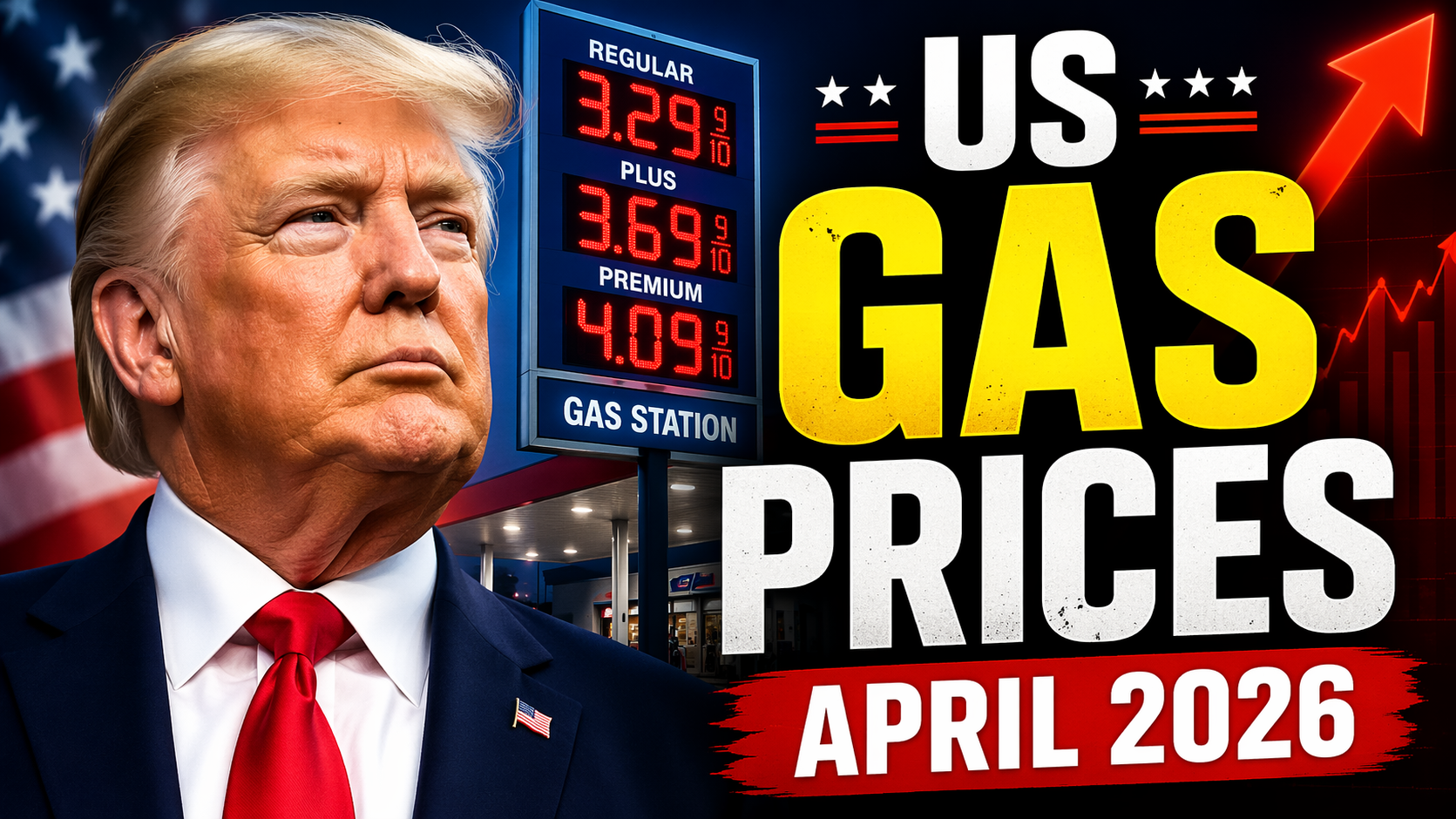
Across the United States, the spring of 2026 has arrived with a heavy price tag at the pump. The national average for regular unleaded gasoline now stands just above four dollars per gallon, with weekly readings fluctuating between roughly four dollars and forty‑two cents, up sharply from the same time last year. This marks one of the steepest year‑on‑year increases seen since the early 2020s, and it comes at a time when many households are already coping with elevated costs for food, housing, and utility bills.
Within that national figure, the pinch is far from uniform. On the West Coast, drivers in California are confronting some of the highest prices in the country, with statewide averages hovering above five dollars and eighty cents per gallon in early April. Nearby states such as Hawaii and Washington are not far behind, with pump prices often breaking five dollars. These coastal markets are especially vulnerable because of higher taxes, stricter environmental regulations, and reliance on imported or reformulated fuel that is more expensive to produce and transport.
At the same time, the Midwest and parts of the South still offer some of the lowest prices in the country, typically in the high‑three‑dollar range, but even there the trend is unmistakably upward. Over the past several weeks, gas prices have climbed in roughly four out of every five states, signaling that the pain is becoming widespread rather than localized. For millions of Americans, this means longer commutes, more expensive road trips, and tougher choices at the checkout line as transportation‑linked inflation feeds through the entire economy.
| Region | Typical April 2026 Price Range | Key Drivers |
|---|---|---|
| West Coast (CA, OR, WA) | $5.50 – $6.00+ | High taxes, reformulated gasoline, shipping constraints |
| Alaska and Hawaii | $5.00 – $5.50 | Heavy reliance on imported fuel and marine transport |
| Northeast (NY, NJ, MA) | $4.20 – $4.70 | Denser road networks, higher taxes, limited local refineries |
| Midwest (IL, OH, IA) | $3.80 – $4.20 | Closer to inland refineries, lower regional taxes |
| South and Plains | $3.70 – $4.00 | Some refinery capacity, lower taxes, but still exposed to global oil shocks |
What’s Behind the Rise? Refining, Taxes, and Seasonal Shifts
While the headline story is about crude oil, the jump in US gas prices cannot be explained by crude alone. Several structural and seasonal factors are tightening the squeeze on drivers.
First, refinery margins have widened significantly. US refiners are operating at high utilization rates, but they are processing a mix of domestic shale crude and imported barrels that have both become more expensive. Maintenance turnarounds, unexpected outages, and tighter environmental compliance requirements have all contributed to a tighter supply of finished gasoline. That means that even if crude prices were stable, the cost of converting it into motor fuel would be higher.
Second, local and state taxes continue to weigh heavily on the pump. States like California, Washington, and New York levy some of the highest per‑gallon excise taxes in the country, sometimes adding more than fifty cents to the price before the fuel even reaches the station. In addition, several states have introduced or increased fees tied to environmental standards and infrastructure repairs, costs that are passed directly to consumers.
Third, the shift to summer‑grade gasoline is underway. Each spring, refiners begin blending cleaner‑burning formulations designed to reduce smog and emissions during the hotter months. These summer blends are more complex and costly to produce, and they typically emerge in the fuel mix by April. As the national supply transitions to this higher‑specification fuel, the price of gasoline often rises even if crude oil is flat.
The Global Oil Supply Crisis: Middle East Conflict and Chokepoints
The most dramatic force behind the current spike, however, is the global oil supply crisis that has intensified in early 2026. A major escalation in the Middle East, involving US and allied actions against Iran and retaliatory strikes that have disrupted key shipping routes, has taken millions of barrels per day offline. According to global energy agencies, the current loss of supply is larger than any of the major oil shocks of the 1970s, 1979, or the early‑2020s conflicts combined.
At the heart of the turmoil is the Strait of Hormuz, a critical maritime chokepoint through which a substantial share of the world’s seaborne oil flows. The conflict has forced many tankers to reroute, delayed shipments, and led to higher insurance premiums for vessels traveling through the region. As a result, global crude markets have tightened abruptly, pushing benchmark prices to multi‑year highs. Brent crude, the international benchmark, has surged by more than half in just a few weeks, and those gains are being passed through to refined products like gasoline and diesel.
The impact is not limited to crude itself. The same conflict has also disrupted flows of liquefied natural gas, petrochemicals, and other energy‑linked commodities. Countries that rely heavily on imported fuel are being forced to pay premiums for spot cargoes, and these strains are being felt in US markets that are increasingly connected to global trade. Even though the US produces a significant share of its own oil, the domestic price of gasoline is still tied to international benchmarks because refiners can always choose to export or import refined products based on global price signals.
Strategic Reserves and Policy Responses
In response to the supply shock, the US government has moved to tap into its strategic reserves. The Department of Energy has announced additional releases from the Strategic Petroleum Reserve, an emergency stockpile designed to mitigate short‑term disruptions. These releases are intended to flood the market with crude and help lower refining input costs, which in turn should ease pressure on gasoline prices over time.
However, energy officials have been careful to emphasize that the reserve is not a magic bullet. The volume released, while substantial in absolute terms, is still a fraction of the shortfall now emerging from conflict‑hit regions. Moreover, the timing of the releases means that the effect will be gradual rather than immediate. Markets have already begun to price in the risk that the global shortfall could persist for months, and refiners are adjusting their production plans accordingly.
Beyond the reserve, policymakers face a complex balancing act. Lowering fuel taxes or imposing temporary price caps might provide short‑term relief at the pump, but they risk creating distortions in the market, such as long lines at stations or reduced investment in refining capacity. At the same time, doing nothing could exacerbate inflation and weigh on consumer spending, which is already a key concern for the Federal Reserve as it manages interest rates.
How the Supply Crunch Is Spreading Beyond Gasoline
The oil shock is not confined to gasoline. Diesel prices have also risen sharply, impacting trucking, freight, and agricultural operations. Higher diesel costs mean more expensive shipping, which is passed on to consumers in the form of pricier groceries, building materials, and manufactured goods. Airlines, too, are feeling the strain as jet fuel costs climb, leading to higher ticket prices and potential schedule adjustments as carriers try to manage fuel‑related expenses.
Even beyond transportation, the energy crunch is affecting industrial production. Many factories rely on petrochemicals and natural gas derivatives as feedstocks, and disruptions in those supply chains can slow output or force companies to switch to alternative materials. This broad impact is why global energy leaders have warned that the current crisis may soon become an “everything crisis,” with ripple effects across inflation, growth, and employment in both advanced and emerging economies.
Regional Differences and What Consumers Can Do
For US drivers, the situation varies by region, but the overall message is clear: expect higher prices in the coming weeks. In the Northeast and on the West Coast, the combination of higher crude costs, tight refining capacity, and heavy local taxes will likely keep pumps above four dollars and often closer to five dollars per gallon. In contrast, parts of the Midwest and the South may see slightly softer increases, especially if new crude deliveries or refined‑product shipments from the Gulf Coast help ease local tightness.
Consumers can take a few practical steps to reduce the bite. Carpooling, combining errands into a single trip, and using public transit where available can all cut fuel consumption. Maintaining proper tire pressure, driving at moderate speeds, and avoiding unnecessary idling can also improve fuel economy. From a longer‑term perspective, switching to a more fuel‑efficient vehicle or even considering hybrid or electric options can help buffer against future spikes, particularly as electricity generation becomes increasingly decoupled from oil markets.
Looking Ahead: Will Prices Keep Rising?
Whether gas prices continue to climb depends heavily on the path of the global conflict and the ability of other producers to fill the gap. Some analysts suggest that if the disruptions in the Middle East persist through April and into the summer, global crude markets could remain tight, keeping pump prices elevated through the peak driving season. Others point to the potential for additional production from US shale operators, who have already signaled plans to ramp up drilling, as well as the possibility of larger releases from strategic reserves abroad.
In the short term, markets will remain sensitive to any news that could escalate or de‑escalate the conflict. A sudden peace agreement or easing of tensions in the Strait of Hormuz could trigger a sharp correction in crude prices, which would eventually ease the pressure at the pump. Conversely, any further military escalation, new attacks on infrastructure, or renewed sanctions could push prices even higher, creating a prolonged period of sticker‑shock for American drivers.
Conclusion: A Signal of Deeper Economic Shifts
The rise in US gas prices in April 2026 is more than just a seasonal blip or a one‑off headline. It is a visible manifestation of a deeper global oil supply crisis, driven by geopolitical conflict, disrupted shipping routes, and constrained refining capacity. For consumers, it means re‑calibrating budgets and travel plans; for policymakers, it means balancing immediate relief with long‑term energy security; and for the broader economy, it means contending with an inflationary force that can ripple through everything from transportation and food to housing and manufacturing.
In this context, the pump at the corner gas station becomes a small window into the interconnectedness of global energy markets. As long as oil remains a central pillar of the world’s transportation system, events thousands of miles away will continue to show up in the price printed on that glowing sign. For now, that price is stubbornly high—and that reality is likely to shape American life through the spring and beyond.

Abhinav Jain is a legal researcher and writer passionate about simplifying complex laws for everyday readers. With a keen interest in Indian constitutional, civil, and digital laws, he focuses on creating accessible, well-researched articles that promote legal awareness among students, professionals, and citizens alike.