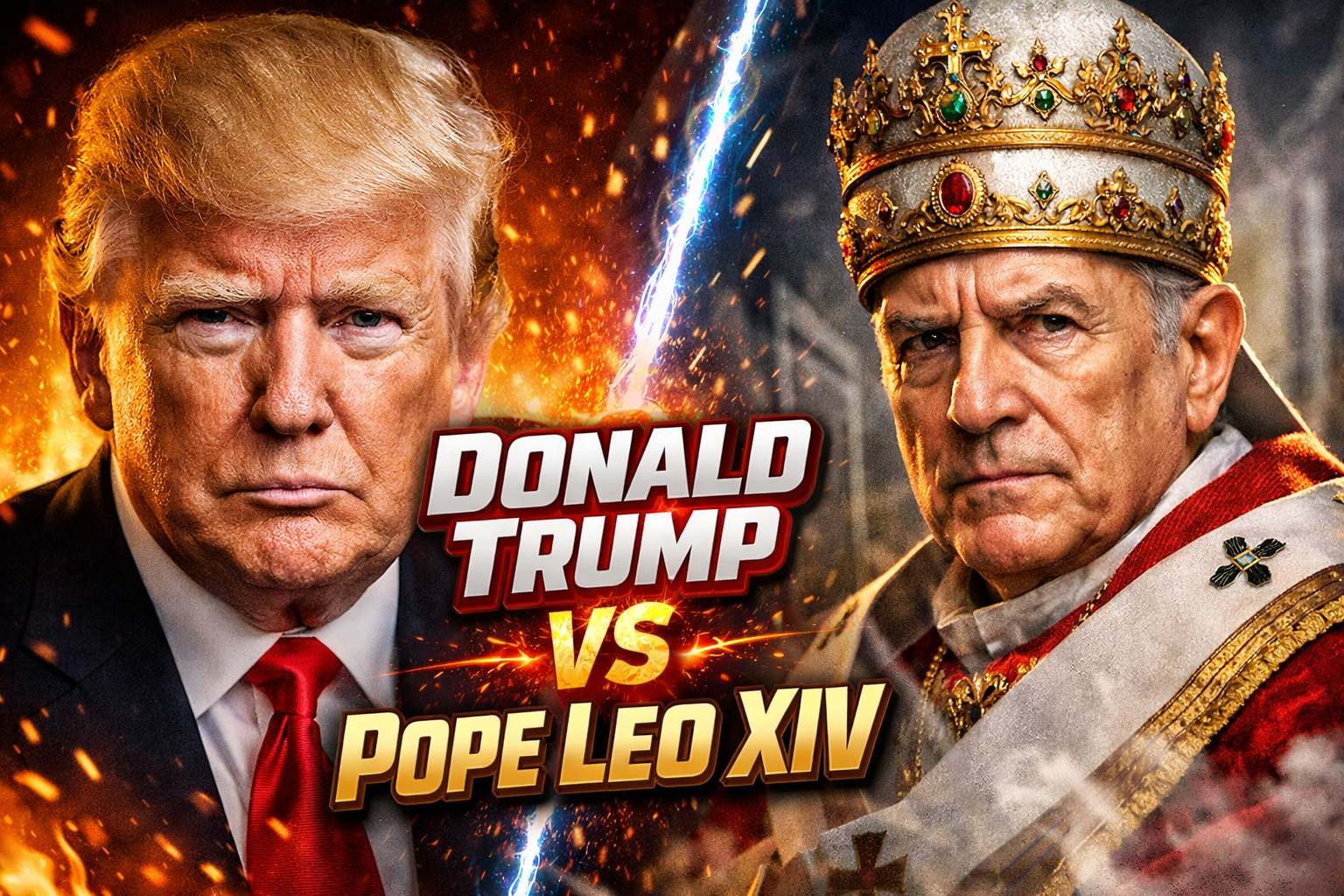
A dramatic public feud has erupted between U.S. President Donald Trump and Pope Leo XIV, the first American-born pontiff, centering on the escalating war with Iran. The Vatican’s sharp condemnation of military actions as a “delusion of omnipotence” has drawn fiery retorts from Trump, who labeled the pope “terrible for foreign policy.” As U.S. naval blockades tighten around the Strait of Hormuz, this clash underscores deep divides over peace, power, and morality.
Introduction
The confrontation unfolded rapidly in early April amid intensified U.S.-Iran hostilities. Pope Leo XIV, speaking from aboard his papal plane and in St. Peter’s Square, urged leaders to halt the “thunderous sound of bombs” and embrace dialogue. Trump responded with unfiltered social media blasts and press remarks, refusing apologies and accusing the pope of weakness.
This rift marks a historic low in U.S.-Vatican relations, pitting Trump’s “maximum pressure” doctrine against Leo’s Gospel-rooted pacifism. With oil prices surging and global trade disrupted, the personal barbs amplify stakes in a conflict already claiming thousands of lives.
Background on Pope Leo XIV
First American Pontiff
Born Robert Francis Prevost in Chicago in 1955 to a Navy veteran father of French-Italian descent and a librarian mother, Leo XIV shattered precedents upon his election on May 8, 2025. Holding dual U.S.-Peruvian citizenship after missionary work in Peru, he became the first pope from a superpower and the Order of Saint Augustine.
Raised with two brothers in a now-defunct Chicago school, Prevost entered seminary young, later serving as a bishop in Peru. His papacy emphasizes mercy, migration, and peace, drawing from American pragmatism and Latin American solidarity. Critics note his progressive stances on climate and poverty, now extending to war condemnation.
Path to Papacy
Elected after Pope Francis’s passing, Leo XIV inherited a Church navigating scandals and secularism. His U.S. roots fueled speculation of influence from Washington, but he has prioritized global south voices. Early addresses focused on unity, yet his Iran stance reveals fearless moral authority.
Escalation of the Iran Conflict
Origins and Timeline
The war ignited February 28, 2026, with U.S.-Israeli airstrikes killing Iran’s Supreme Leader Ayatollah Ali Khamenei, following claims of nuclear restarts and missile threats. Iran retaliated with drones and missiles on Israel, U.S. bases, and Gulf allies, closing the Strait of Hormuz.
Trump’s State of the Union boasted of crippling Iran’s economy via sanctions, demanding unconditional surrender. March saw aerial campaigns targeting naval assets; ultimatums threatened power plants and desalination facilities. A Pakistan-brokered two-week ceasefire frayed as Iran refused Hormuz reopening amid Israeli Lebanon strikes.
Recent Developments
On April 13, Trump announced a U.S. naval blockade, vowing to “eliminate” Iranian ships and intercept toll-payers. Iran decried it as “piracy,” with traffic halted and oil climbing. JD Vance’s Islamabad talks collapsed April 12, prompting Trump’s no-negotiation stance.
| Phase | Key Events | Casualties (Approx.) |
|---|---|---|
| Initial Strikes (Feb 28-Mar) | Khamenei killed; Hormuz closed | 2,076 Iranian deaths (240 women, 212 children); 26 Israeli, 13 U.S. |
| Retaliation (Mar) | Missiles on bases, Gulf states | 3,500+ Iranian total; 373 U.S. wounded |
| Ceasefire (Apr 8-12) | Pakistan mediation fails | 26,500+ Iranian injured |
| Blockade (Apr 13+) | Naval enforcement begins | Ongoing escalations |
Vatican’s Position on the War
Papal Appeals for Peace
Pope Leo has issued repeated pleas since day one. March 1: “Halt the spiral of violence before an irreparable abyss.” March 8: End “thunderous bombs” for dialogue. April 6 from Castel Gandolfo: Trump’s threats “truly unacceptable,” urging an “off-ramp.”
He called congregants to contact leaders for peace, rejecting war’s invocation of God. Cardinal Pietro Parolin warned of global spirals from bombings.
Critique of Military Actions
Labeling drivers a “delusion of omnipotence,” Leo framed the conflict as moral failure, prioritizing civilian lives over strategic gains. U.S. bishops echoed, condemning civilian targeting.
Trump’s Response and Policy
Aggressive Rhetoric
Trump’s April 12 Truth Social post blasted Leo as “weak on crime, terrible for foreign policy,” urging focus on being pope, not politician. At Joint Base Andrews: “Not doing a very good job… I’m not a big fan.” He doubled down April 13-14, refusing apology amid backlash.
Policy roots in “maximum pressure”: sanctions collapsed rial, strikes aimed at missiles/nuclear sites. Threats targeted infrastructure for Hormuz compliance; victory claims preceded escalations.
Defense of Actions
Trump portrays war as preemptive against existential threats, eyeing regime change via opposition like Reza Pahlavi. Blockade enforces navigation freedom for non-Iranian ports, per CENTCOM.
The Public Feud Timeline
Escalating Exchanges
- Feb 28-Mar: Leo prays for peace post-Khamenei strike.
- Apr 6: Leo deems threats “unacceptable.”
- Apr 11: Leo demands negotiation over “omnipotence.”
- Apr 12: Trump attacks on social media; Vance talks fail.
- Apr 13: Leo aboard plane: “No fear” of Trump; blockade starts.
- Apr 14: Trump: No apology; rift deepens.
Reports allege U.S. pressure on Vatican for support, denied as routine.
| Date | Leo’s Statement | Trump’s Retort |
|---|---|---|
| Apr 6 | Threats “truly unacceptable” | – |
| Apr 11 | Reject war; contact leaders | – |
| Apr 12 | Gospel-rooted peace appeals | “Terrible for policy; stop politics” |
| Apr 13 | “No fear” of administration | Blockade announcement; no apology |
Broader Implications
Humanitarian Toll
Over 3,500 Iranian dead (1,665 civilians), 26,500 injured; 13 U.S. fatalities, 373 wounded. 3.2 million displaced; 25 hospitals damaged. Gulf ripples hit UAE, Bahrain.
Global Reactions
China, Europe urge restraint; oil surges disrupt trade. Catholic leaders inspired by Leo; U.S. conservatives back Trump.
U.S.-Vatican Relations
Historic strain: first superpower pope challenges home president. Leo’s response reveals “man of God, not politics.”
Potential Paths Forward
Diplomatic windows persist via Pakistan or neutrals. Leo pushes ceaseless appeals; Trump eyes quick victory. Stalemate risks wider war.
Conclusion
Trump vs. Leo XIV embodies power versus principle amid Iran’s flames. As blockades bite and voices clash, the world watches if morality sways might or escalates catastrophe. Peace hangs by dialogue’s thread.

Abhinav Jain is a legal researcher and writer passionate about simplifying complex laws for everyday readers. With a keen interest in Indian constitutional, civil, and digital laws, he focuses on creating accessible, well-researched articles that promote legal awareness among students, professionals, and citizens alike.