
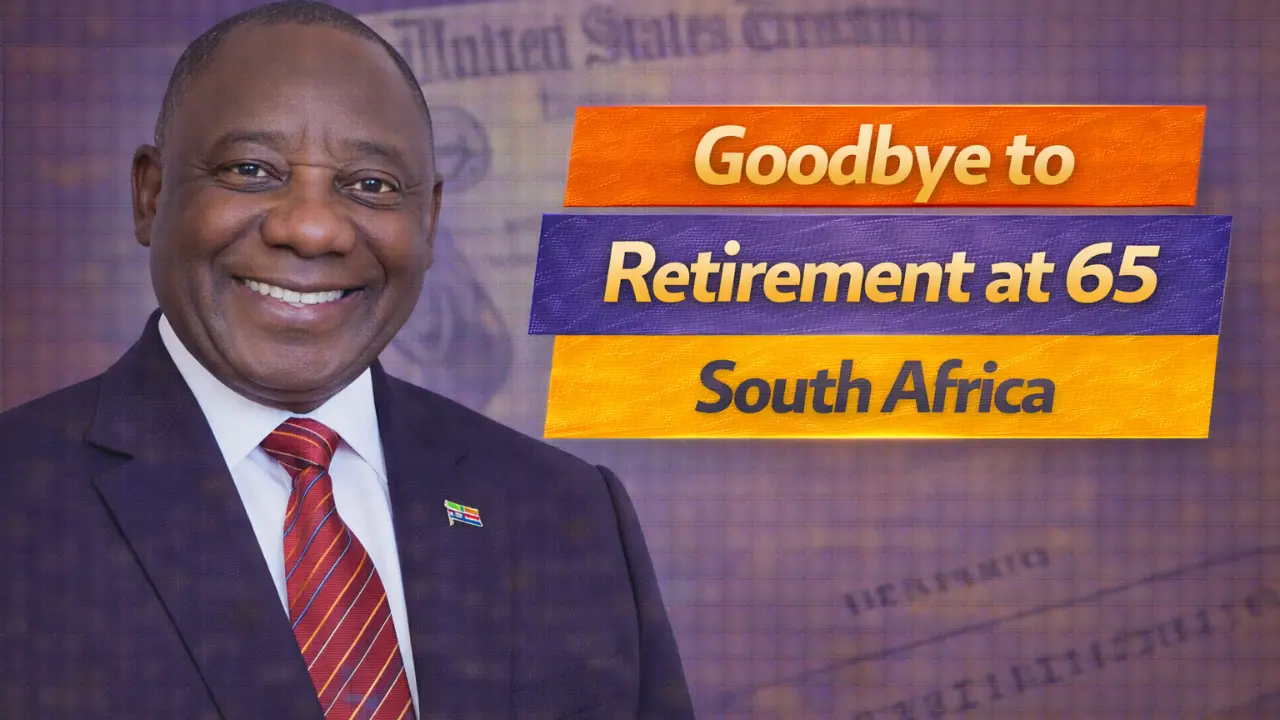
A wave of online claims and mixed reports in late 2025 and early 2026 has left workers, pensioners and HR departments across Government Employees Pension Fund and the private sector asking the same question: has the fixed benchmark of retirement at 65 — or, historically in some contexts, 60 — been quietly swept aside? This article untangles what has actually changed, what remains the same, and what this means for people planning the end of their working lives.
What triggered the confusion
Over the past months a series of social-media posts, copied documents and speculative commentary circulated claiming that the statutory retirement age had been raised — in some versions to 67, in others to 70 — or that the default retirement age was abolished entirely. These messages took several different forms: screenshots of alleged government notices, commentary by private pension advisers, and rapid reposts across platforms. Some of these claims referenced regulatory instruments or pension-fund decisions; others were outright misinterpretations of draft proposals or foreign reforms. Independent checks and formal statements from pension administrators show the situation is more nuanced than the viral headlines suggested.
The official position: what administrators have said
Key public bodies and major pension administrators have pushed back on blanket claims of a national uplift in statutory retirement age. The Government Employees Pension Fund publicly denied that its normal retirement age had been changed for GEPF members, reiterating its existing categories of early, normal and late retirement. Parallel statements from government social-benefit channels confirm that the qualifying age for the state older person’s grant remains unchanged for the general population. These denials are the authoritative baseline for anyone responding to viral claims.
What the rules actually say today
South Africa’s retirement and old-age benefit landscape is layered:
- Private retirement funds and employer pension schemes frequently set their own “normal retirement ages” (often 60 or 65) in plan rules.
- The state older-person’s grant (the social assistance payment often referred to as the old-age pension) is paid to qualifying applicants aged 60 and above under current government rules.
- Some public-sector pension schemes maintain specific ages for early, normal and late retirement that differ from private-sector norms.
That mix — private plan rules, statutory grant eligibility and scheme-specific provisions — explains why a single headline about “the retirement age” can be misleading: different systems use different benchmarks.
Why reform keeps appearing in headlines
Two structural pressures explain why the retirement-age question keeps resurfacing:
- Fiscal sustainability: governments and large pension funds worldwide are evaluating longer life expectancy and the budgetary consequences of people spending more years in retirement.
- Labour-market and demographic shifts: with an ageing population and persistent unemployment among younger cohorts, policymakers face difficult trade-offs between keeping older workers in the labour force and creating opportunities for younger entrants.
Internationally, some jurisdictions have announced gradual increases or mechanisms to index retirement age to life expectancy. These global debates and examples fuel speculation domestically, even when no concrete local policy change has been enacted.
The realistic reform scenarios people should watch for
If South Africa moves to revise retirement-related rules, the following pathways are most plausible and commonly discussed by policy experts:
- Gradual statutory increases for specific benefits (for example, indexing the qualifying age for a contributory pension to life expectancy).
- Differentiated rules based on years of contributions (people with long contribution histories retire earlier than those with shorter careers).
- Abolition of a uniform default retirement age inside employment law while leaving employers to set plan-specific ages.
- Expansion of phased-retirement or flexible-retirement options that decouple access to benefits from a single chronological age.
None of these pathways necessarily means a sudden, across-the-board jump in eligibility or entitlement; they typically require legislation, stakeholder consultation, and transition periods.
Quick facts and headline stats
| Item | Current conventional benchmark |
| State older-person’s grant eligibility age | 60 years for qualifying applicants. |
| Typical private/occupational normal retirement ages | Many plans use 60 or 65 depending on sector and plan rules. |
| Public-sector scheme standard (example) | GEPF continues to list early, normal and late retirement categories; no nationwide increase announced by GEPF. |
| Recent misinformation trend | Viral claims in late 2025–early 2026 falsely attributed blanket increases to several funds and government sources. |
What this means for workers and retirees
- If you’re within five years of your planned retirement: keep monitoring official channels (employer HR, pension-fund notices, and government social-benefit pages). Consider confirming individual plan provisions — those determine your entitlements.
- If you’re a younger worker: consider that policy shifts tend to be gradual. Increasing contribution rates, longer careers, and phased-retirement products may become more important to secure the same retirement income.
- For employers and plan administrators: ensure communication is clear to prevent panic; any proposed changes require legal compliance and stakeholder engagement.
Practical checklist for people worried about changes
- Request a written statement of your plan’s normal and early retirement ages.
- Confirm eligibility rules for any state grants you may claim.
- Do a readiness audit: project income needs, review investment choices, and consider topping up contributions where feasible.
- Seek independent actuarial or financial-advice opinion if your pension pot is large or complex.
Voices from the field
Pension specialists caution that headlines rarely capture the full suite of technical trade-offs in retirement policy — actuarial fairness, intergenerational equity, and labour-market impacts among them. Meanwhile, advocacy groups warn that raising ages without targeted support for physically demanding occupations or low-income workers risks deepening poverty among vulnerable older adults.
Table: Example comparative scenarios (illustrative)
| Scenario | Who it affects | Likely transition features |
| Indexing entitlement age to life expectancy | Broad population receiving contributory pensions | Phased increases, automatic review periods |
| Higher contribution requirement to keep benefit level | Active workers across sectors | Gradual increases, opt-out protections for hardship |
| Longer career credit for earlier retirement | Long-tenure workers | Benefits tied to years of service, not just age |
Commonly asked questions
Will my social grant be cut or delayed because of a higher retirement age?
No official policy raising the state older-person’s grant qualifying age has been enacted; current state-grant rules remain in force. Always check the official government benefit pages for confirmation.
Has the Government Employees Pension Fund changed its retirement rules?
GEPF publicly denied changes to its normal retirement age and warned against misinformation; individual GEPF members should verify their own benefit statements.
Are claims that the retirement age is now 67 or 70 true?
Multiple fact-checks and fund statements have shown blanket claims are inaccurate or misattributed. Some documents circulating online related to particular schemes or foreign examples, not a nationwide statutory change.
If the retirement age rises in future, will there be a transition?
Reforms of this magnitude typically include phased approaches, grandfathering, and carve-outs for certain worker categories. Expect long lead times and legal consultation processes.
Conclusion
The “secret” behind the 2026 headlines is not a single dramatic policy switch but a tangle of real pressures, speculative reporting and an understandable public sensitivity to anything that could shorten retirement opportunities. For now, the authoritative instruments — pension-fund statements and government social-benefit rules — show no sudden, universal increase in statutory entitlement ages. That does not preclude measured reforms in the future. For individuals and employers, the practical response is straightforward: verify plan rules, plan for contingencies, and follow official announcements rather than social-media summaries.
