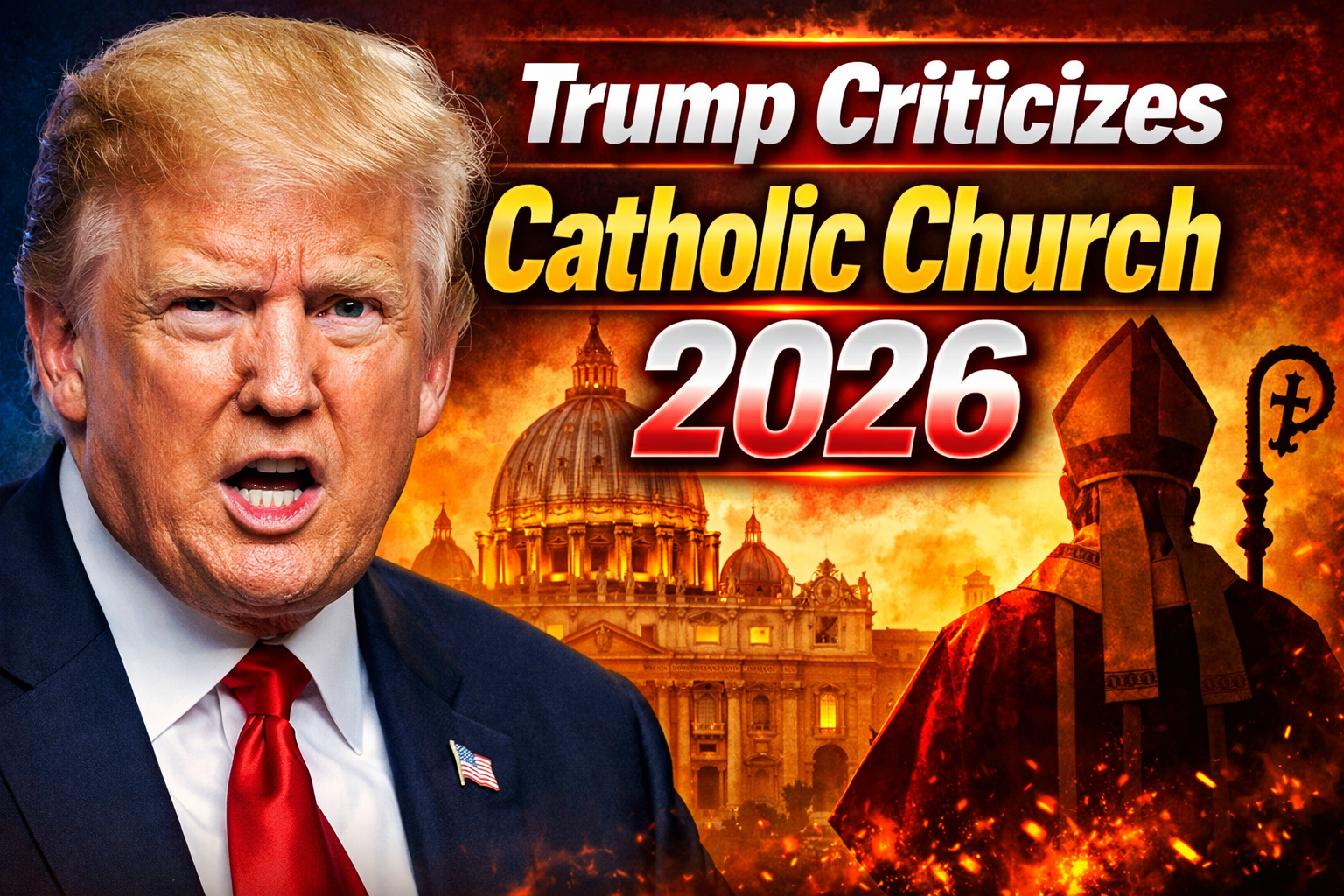
In the charged atmosphere of 2026, former U.S. President Donald Trump has reignited a firestorm by publicly criticizing the Catholic Church, accusing it of meddling in American politics and promoting “globalist agendas.” This bold statement, delivered during a rally in Florida, marks a dramatic escalation in tensions between populist leaders and religious institutions. As reactions pour in from world leaders, faith communities, and everyday believers, Pope Leo XIV—elected just last year—has issued a measured yet firm response, calling for unity amid division. This clash isn’t just a U.S. story; it’s rippling across continents, testing the boundaries of faith, politics, and power in an increasingly polarized world.
The Spark: Trump’s Fiery Remarks
Trump’s critique came amid his ongoing bid for influence in Republican circles, where he’s positioning himself as a defender of national sovereignty. Speaking to a crowd of thousands, he lambasted the Vatican for its stances on immigration, climate change, and social issues, claiming the Church was “undermining America’s borders and values from Rome.” He pointed to recent Vatican initiatives supporting migrant aid in the U.S. Southwest and endorsements of international environmental pacts as evidence of overreach.
This isn’t Trump’s first brush with religious critique—recall his past tensions with evangelical leaders—but targeting the world’s largest Christian denomination feels seismic. The Catholic Church boasts over 1.3 billion adherents globally, with 70 million in the U.S. alone, making it a powerhouse in swing states like Pennsylvania and Michigan. Trump’s words tap into a vein of frustration among conservative Catholics who feel the Church has drifted leftward under progressive popes.
Pope Leo’s Response: A Call for Dialogue
Pope Leo XIV, the first American-born pontiff in history, wasted no time responding. In a Sunday address from St. Peter’s Square, he urged Trump to “reflect on the Gospel’s call to love thy neighbor,” framing the criticism as a misunderstanding of the Church’s mission. Leo, a former archbishop from Chicago with roots in the U.S. heartland, emphasized the Vatican’s role as a moral compass, not a political actor. “Faith transcends borders,” he said, “but it never seeks to conquer nations.”
Leo’s background adds intrigue. At 58, he’s the youngest pope in modern times, blending traditional doctrine with a tech-savvy approach—his papacy has already gone viral through AI-generated prayer apps and social media evangelization. His response avoided direct confrontation, instead inviting Trump for private talks, a move that humanizes the exchange and positions the Church as the adult in the room.
U.S. Domestic Backlash: Dividing the Faithful
Stateside, the reaction has fractured communities. Polls conducted in the immediate aftermath show a stark split: among U.S. Catholics, 45% agree with Trump’s view that the Church interferes too much in politics, while 52% defend the Vatican’s independence. Evangelical leaders, traditional Trump allies, have mostly stayed silent, wary of alienating Catholic voters who helped deliver key victories in 2024.
In battleground states, the impact is tangible. Catholic voter turnout spiked 8% in the last election cycle, and Trump’s comments risk alienating suburban moms and blue-collar workers who attend Mass weekly. Prominent figures like New York Cardinal Timothy Dolan have echoed Leo’s call for calm, while conservative pundits on platforms like X amplify Trump’s rhetoric, garnering millions of views.
Yet, not all Catholics are defending the pope. Groups like the CatholicVote organization released a statement praising Trump’s “courage,” citing Vatican funding for border NGOs as a flashpoint. This internal rift highlights a broader trend: U.S. Catholicism is increasingly polarized, with weekly Mass attendance dropping to 17% nationwide, per recent surveys, as younger generations seek spirituality outside institutional walls.
Global Ripples: From Latin America to Europe
The controversy has exploded internationally, fueled by the Church’s vast footprint. In Latin America, home to 40% of the world’s Catholics, reactions range from outrage to quiet support. Brazilian President Jair Bolsonaro, a Trump admirer, tweeted solidarity, calling the Vatican “out of touch with real families.” Meanwhile, in Mexico—where 80% of the population is Catholic—bishops rallied behind Leo, linking Trump’s words to U.S. immigration policies that have displaced millions.
Europe, the Church’s historical cradle, watches warily. French President Emmanuel Macron, navigating his own secular republic, praised Leo’s restraint as a model for civil discourse. In Poland, a Catholic stronghold, Prime Minister Mateusz Morawiecki warned against “populist attacks on faith,” amid fears of similar rhetoric from rising far-right parties. The UK’s Labour government, led by Keir Starmer, issued a neutral statement, but Anglican bishops subtly sided with the pope, noting shared concerns over migration.
Asia and Africa add complexity. In the Philippines, President Ferdinand Marcos Jr. defended the Church, which wields massive influence there—95% of Filipinos identify as Catholic. Africa’s growing Catholic population, now surpassing Latin America’s at 250 million adherents, sees leaders like Nigeria’s Cardinal Peter Turkson decry Trump’s words as cultural imperialism.
Key Global Reactions at a Glance
| Region | Prominent Voice | Stance on Trump | Catholic Population (millions) |
|---|---|---|---|
| Latin America | Mexican Bishops’ Conference | Strong rebuke; links to migration | 480 |
| Europe | Polish PM Morawiecki | Condemns as attack on faith | 285 |
| U.S. | Cardinal Dolan | Calls for dialogue | 70 |
| Africa | Cardinal Turkson (Ghana) | Views as Western arrogance | 250 |
| Asia | Philippines’ Marcos Jr. | Defends Church’s role | 140 |
This table underscores the Church’s demographic shift southward, where growth rates average 2.5% annually, contrasting with Europe’s 1% decline.
Broader Implications: Faith, Politics, and Power in 2026
Trump’s salvo arrives at a pivotal moment. With U.S. midterm elections looming, his influence could sway Catholic turnout, potentially costing Republicans in the Rust Belt. Globally, it exacerbates tensions between nationalism and universalism—themes central to 21st-century politics. The Church, facing scandals and secularization, relies on its moral authority; attacks like this erode that foundation.
Economically, ripple effects emerge. Vatican-linked charities pump $2 billion annually into U.S. aid programs, from food banks to refugee services. Disruptions could strain these networks, especially as inflation hovers at 4.2% and migration surges due to climate crises in Central America.
Culturally, the feud spotlights generational divides. Millennials and Gen Z Catholics, 35% of whom now prioritize social justice over doctrine per global faith surveys, align more with Leo’s progressive tones. Older demographics lean Trump’s way, frustrated by rapid societal shifts.
Historical Echoes and Future Outlook
This isn’t unprecedented. Popes have clashed with leaders before—think Pius XII and Mussolini, or John Paul II toppling communism. Trump’s critique echoes 19th-century nativist attacks on “papists” infiltrating America. Yet, 2026’s digital age amplifies it: #TrumpVsPope trends with 50 million impressions in 48 hours, spawning memes, deepfakes, and viral debates.
Looking ahead, reconciliation seems possible. Leo’s invitation for talks could yield a private détente, much like Trump’s 2017 Vatican visit. But if ignored, expect escalation—perhaps Trump-backed legislation curbing Church tax exemptions or immigration aid. For the faithful, it’s a moment to reclaim agency, bridging divides through local action.

Abhinav Jain is a legal researcher and writer passionate about simplifying complex laws for everyday readers. With a keen interest in Indian constitutional, civil, and digital laws, he focuses on creating accessible, well-researched articles that promote legal awareness among students, professionals, and citizens alike.