
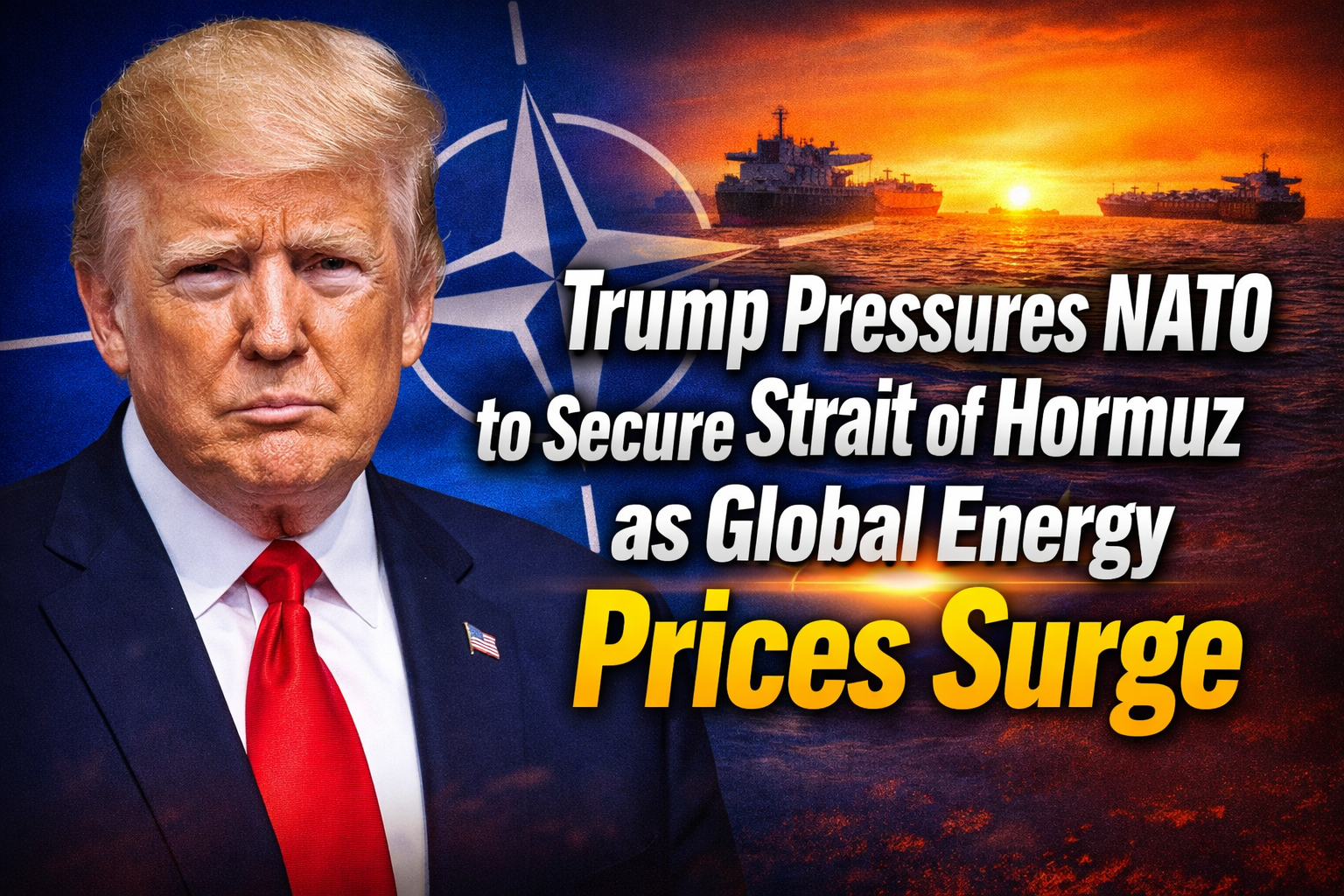
President Donald Trump has issued a stark ultimatum to NATO allies, demanding they commit naval forces to reopen the Strait of Hormuz amid skyrocketing global energy prices. This bold move comes as disruptions in this vital waterway push oil markets into turmoil, threatening economies worldwide.
Current Crisis in the Strait of Hormuz
The Strait of Hormuz, a narrow passage between Iran and Oman, serves as the world’s most critical oil chokepoint. Roughly one-fifth of global oil supplies, along with substantial liquefied natural gas shipments, flow through its waters daily. Recent escalations in tensions between the United States, Israel, and Iran have led to an effective blockade, halting tanker traffic and sending shockwaves through energy markets.
Iranian forces, responding to U.S. strikes on key oil infrastructure like Kharg Island, declared the strait closed to commercial shipping. This island handles nearly all of Iran’s oil exports, and its partial destruction has crippled Tehran’s export capacity. Senior Iranian officials have vowed to keep the strait shut until their demands are met, warning of further disruptions to regional pipelines and facilities.
President Trump, in recent interviews, described the U.S. military actions as decisive, claiming they have “totally demolished” critical Iranian assets. He has repeatedly urged allies to join a multinational effort to escort tankers and secure the passage, framing it as a test of collective resolve against Iranian aggression.
Trump’s Push for NATO Involvement
Trump’s pressure on NATO marks a dramatic shift in alliance dynamics. In a Financial Times interview, he warned that failure to support the mission could spell a “very bad” future for the alliance, hinting at reduced U.S. commitments elsewhere. This comes after his inauguration earlier this year, where he pledged to prioritize American interests while expecting burden-sharing from partners.
The proposal calls for NATO warships to patrol the strait, ensuring safe passage for oil tankers bound for Europe, Asia, and beyond. Trump has singled out major oil-importing nations like those in Europe and Japan, arguing they have the most to lose from prolonged closures. However, initial responses have been tepid—Japan and Australia have declined to deploy vessels, citing domestic priorities and risks of escalation.
This initiative echoes Trump’s first-term tactics of using economic leverage to rally allies. By tying NATO’s credibility to the Hormuz mission, he aims to redistribute defense costs, a long-standing grievance. Critics within the alliance worry this could dilute focus on core threats like Russia, while supporters see it as a necessary evolution in a multipolar world.
Key Elements of the Proposed Coalition
- Naval escorts for commercial tankers transiting the strait.
- Joint air patrols over the Persian Gulf to deter Iranian interdictions.
- Shared intelligence on Iranian naval movements and missile threats.
- Logistics hubs in friendly Gulf states like the UAE and Saudi Arabia.
Surging Global Energy Prices
Oil prices have rocketed past critical thresholds due to the Hormuz crisis. Brent crude, the global benchmark, has climbed above levels not seen since major geopolitical shocks years ago, with West Texas Intermediate futures following suit. Markets now price in prolonged uncertainty, with traders betting on prices nearing even higher marks if the strait remains blocked.
Asia, the largest importer of Gulf oil, faces the brunt of the surge. Refineries in India, China, and South Korea scramble for alternatives, driving up spot prices for supplies from the U.S. and Russia. European nations, weaning off Russian energy, confront dual pressures from higher imports and strained budgets.
Consumers worldwide feel the pinch at fuel pumps and in heating bills. Airlines ground flights, shipping firms reroute vessels around Africa—adding weeks and costs—and manufacturing slows as input prices soar. Central banks contemplate rate adjustments to combat imported inflation, complicating recoveries from prior economic headwinds.
Energy Price Impacts by Region
| Region | Pre-Crisis Oil Price (per barrel) | Current Price (per barrel) | Key Affected Sectors |
|---|---|---|---|
| North America | Around baseline levels | Sharp uptick | Transportation, petrochemicals |
| Europe | Moderate imports | Significant rise | Heating, power generation |
| Asia-Pacific | Heavy Gulf reliance | Steepest surge | Refining, plastics manufacturing |
| Middle East | Local production buffers | Moderate increase | Export revenues, desalination |
Geopolitical Ramifications
The Hormuz standoff risks broader conflict. Iran’s new leadership under Mojtaba Khamenei has hardened rhetoric, promising retaliation against any coalition forces. Revolutionary Guard commanders threaten to ignite passing ships and target pipelines, potentially ensnaring Saudi and UAE facilities.
Russia and China watch closely, offering tacit support to Iran while boosting their own oil exports. Moscow benefits from diverted demand, filling European gaps, while Beijing secures discounted Iranian crude via alternative routes. This realignment challenges U.S. dominance in global energy security.
Domestically, Trump leverages the crisis to tout U.S. energy independence. Shale production ramps up, positioning America as a supplier to allies. Yet, vulnerabilities persist—refined products like jet fuel still rely on global flows.
Economic Statistics and Projections
Global oil demand hovers near record highs, exacerbated by post-pandemic rebounds and harsh winters. The strait normally facilitates over twenty million barrels daily; its closure equates to removing major producers like Saudi Arabia from the market.
Analysts project stark scenarios:
- Short-term closure (weeks): Prices stabilize around current highs.
- Medium-term (months): Potential climb to extreme levels, triggering recessions.
- Long-term: Accelerated shift to renewables, though infrastructure lags.
Inflation metrics reflect the strain. Energy components now dominate consumer price indices, pushing headline figures higher. Stock markets wobble, with energy firms gaining while airlines and retailers falter.
Global Oil Flow Disruptions
| Commodity | Daily Volume Through Strait (million tons) | Alternative Routes Available | Price Sensitivity |
|---|---|---|---|
| Crude Oil | Over twenty | Limited (pipelines, Africa) | Extremely high |
| LNG | Significant portion | Qatar bypasses | High |
| Refined Products | Growing volumes | Tanker rerouting | Moderate |
NATO Allies’ Responses and Challenges
European NATO members grapple with the summons. Germany, reliant on Gulf LNG, hesitates due to public aversion to Middle East entanglements. France and the UK express willingness for limited support but demand clear exit strategies.
Legal hurdles loom—UN Security Council authorization falters amid Russian and Chinese vetoes. Domestic politics in ally nations complicate deployments; elections and budgets constrain action.
Trump’s approach—public shaming via media—pressures holdouts. He contrasts U.S. sacrifices with allied reticence, invoking past imbalances in defense spending.
Potential Pathways Forward
Reopening the strait demands diplomacy alongside force. Backchannel talks with Oman, a neutral mediator, could yield safe passages. Incentives like U.S. LNG exports might sway Asia.
Technological edges aid coalitions: Drones for surveillance, AI-driven threat detection, and precision munitions deter Iranian swarms. Yet, asymmetric warfare—mines, speedboats—poses risks.
Longer-term, diversification beckons. Pipeline expansions in the UAE and Saudi Arabia bypass portions of the strait. Strategic reserves release provides breathing room, buying time for resolutions.
Implications for Global Energy Security
This crisis underscores the fragility of chokepoints. Nations accelerate “friendshoring” supplies, favoring stable producers like Norway and Brazil. Renewables gain urgency, though intermittency limits near-term offsets.
For Trump, success burnishes his strongman image, vindicating aggressive postures. Failure risks alliance fractures and economic fallout on his watch.
Consumers brace for sustained pain. Higher energy costs ripple into food, goods, and services, testing resilience.
Broader Strategic Shifts
The Hormuz drama accelerates multipolar trends. OPEC+ maneuvers fill voids, while U.S. fracking surges. Geopolitical insurance premiums rise, padding defense budgets.
Iran’s isolation deepens, potentially spurring nuclear pursuits or proxy escalations. Allies recalibrate, weighing U.S. reliability against autonomous capabilities.
In this high-stakes game, Trump’s NATO gambit tests wills. Securing the strait preserves flows; faltering invites chaos. Global economies hang in balance, awaiting coalition resolve.

Abhinav Jain is a legal researcher and writer passionate about simplifying complex laws for everyday readers. With a keen interest in Indian constitutional, civil, and digital laws, he focuses on creating accessible, well-researched articles that promote legal awareness among students, professionals, and citizens alike.