
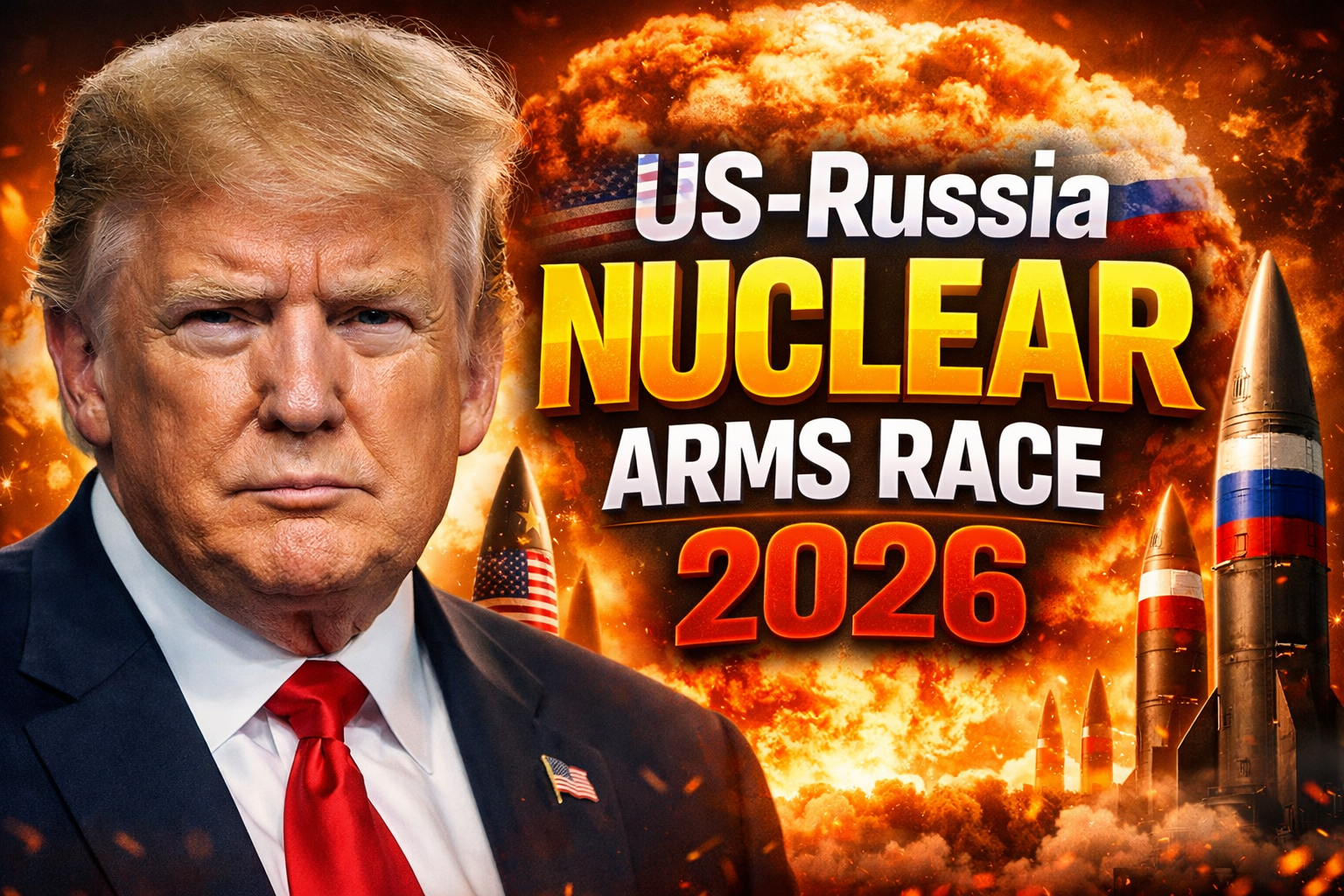
The expiration of the New START treaty on February 5, 2026, has ushered in an era without binding limits on U.S. and Russian strategic nuclear arsenals, heightening fears of a renewed arms race between the two superpowers. With both nations possessing over 85 percent of the world’s nuclear warheads, the loss of verification and caps raises the specter of unconstrained buildup and heightened global tensions.

Background on New START Treaty
New START, signed in 2010 and extended in 2021, limited each side to 1,550 deployed strategic warheads, 700 deployed delivery vehicles, and 800 total launchers. It included robust verification through on-site inspections, data exchanges, and notifications, fostering transparency amid post-Cold War reductions. Russia suspended participation in 2023 citing U.S. arms aid to Ukraine, but both pledged adherence until expiration.
The treaty’s end marks the collapse of bilateral arms control, following earlier pacts like START I and II. Despite last-minute talks involving U.S. envoys and Russian officials, no extension materialized, partly due to U.S. insistence on including China’s growing arsenal.
Current Nuclear Stockpiles and Deployments
As of early 2026, the U.S. maintains about 5,044 total warheads, with 1,419 deployed strategic under prior limits, plus 100 gravity bombs and submarine-launched cruise missiles. Russia holds roughly 5,459 warheads, deploying 1,549 strategic, alongside 1,000-2,000 tactical weapons not covered by New START.
Both adhered to caps pre-expiration, but modernization accelerates. The U.S. deploys Minuteman III ICBMs, Trident II SLBMs on Ohio-class subs, and B-52/B-2 bombers. Russia fields RS-24 Yars ICBMs, Borei-class subs with Bulava missiles, and Tu-95/160 bombers.
| Category | United States | Russia |
|---|---|---|
| Total Inventory | ~5,044 | ~5,459 |
| Deployed Strategic Warheads | ~1,419 | ~1,549 |
| Tactical/Non-Strategic | ~100 | ~1,500-2,000 |
| Delivery Vehicles (Deployed) | ~660 | ~540 |
These figures underscore parity in strategic forces but Russia’s edge in tactical nukes.
US Nuclear Modernization Programs
The U.S. pursues a trillion-dollar overhaul through 2030s, replacing all legs of its triad. Ground-based: Sentinel ICBMs to succeed Minuteman III by 2030, with 659 missiles planned. Sea-based: Columbia-class subs starting 2031, carrying 16 Trident II D5LE missiles each. Air-based: B-21 Raider bombers entering service soon, paired with Long-Range Standoff (LRSO) cruise missiles.
New low-yield W76-2 warheads on subs and B61-12 gravity bombs enhance flexibility. Plutonium pit production ramps to 80 annually at Los Alamos and Savannah River for new cores.
Russian Nuclear Modernization Efforts
Russia modernizes 95 percent of its strategic forces, deploying Sarmat (RS-28) super-heavy ICBMs with MIRV capabilities, Yars-M mobile missiles, and Avangard hypersonic gliders. Navy: Upgraded Borei-A subs and Yasen-M cruisers with Kalibr/Oniks missiles. Air: Upgraded Tu-160M and PA-800 bombers.
Tactical upgrades include Iskander-M missiles and Poseidon nuclear torpedoes. Doctrine revisions lower nuclear use thresholds amid Ukraine conflict, signaling readiness for escalation.
Immediate Risks Post-New START Expiration
Without inspections, opacity breeds mistrust; satellite monitoring cannot match on-site data. Both may exceed 1,550 deployed warheads soon, with Russia potentially uploading to existing missiles and U.S. fielding more bombers. Miscalculation risks rise in crises like Ukraine or Taiwan.
China’s arsenal, nearing 600 warheads and eyeing 1,000 by 2030, complicates dynamics, as U.S. seeks trilateral talks rejected by Beijing.
Potential for Arms Race Escalation
Post-expiration, projections warn of rapid buildup: U.S. could reach 1,700-2,000 deployed by 2030 absent controls; Russia mirrors via reserve uploads. Hypersonics, AI command systems, and dual-capable missiles blur conventional-nuclear lines, spurring “use it or lose it” pressures.
SIPRI notes a “dangerous new arms race” looming, with global stockpiles stable but diversity increasing. Europe’s hosting of U.S. weapons and NATO exercises fuel Russian paranoia.
Geopolitical Tensions Fueling the Race
Ukraine war intensifies dynamics: Russia’s 2022 annexations and U.S. ATACMS supplies prompt nuclear saber-rattling. Putin’s lowered thresholds contrast Trump’s “peace through strength,” eyeing arms deals. Middle East volatility and Arctic competition add flashpoints.
Trilateral failure leaves bilateral talks stalled, as Russia demands NATO pullbacks and U.S. missile defense curbs.
Technological Advancements and New Threats
Hypersonic weapons evade defenses: Russia’s Kinzhal and Avangard, U.S. ARRW. AI in early warning risks false alarms; cyber vulnerabilities threaten command chains. Fractional orbital bombardment systems revive Cold War fears.
Boost-glide vehicles and maneuverable reentry bodies challenge intercepts, driving penetration aid investments.
Global Implications and Multilateral Concerns
The duo’s 90 percent warhead share impacts allies: NATO bolsters deterrence, France/UK modernize independently. China accelerates triad completion; India-Pakistan tensions simmer. Non-proliferation erodes as Iran, North Korea advance.
UN chief urges new talks; Guterres warns of “moment for peace” lost.
Pathways to Risk Mitigation
Informal understandings could cap deployments temporarily. Track-II dialogues via Norway or Geneva might rebuild trust. Congressional resolutions or executive initiatives push transparency pledges.
Multilateral frameworks like P5 dialogues offer hope, emphasizing no-first-use or risk reduction centers.
Expert Assessments and Warnings
Arms controllers decry “crisis” in control regimes; FAS predicts unconstrained race. UCS warns of ticking clock to buildup. SIPRI Yearbook 2025 highlights modernization stresses.
Optimists note mutual deterrence stability, but polls show public anxiety over escalation.
Future Scenarios and Policy Recommendations
Worst-case: Unlimited buildup to Cold War levels, crisis missteps. Best: Trump-Putin summit yields successor pact. Recommendations include resuming data swaps, banning new warhead types, and trilateral talks.

Abhinav Jain is a legal researcher and writer passionate about simplifying complex laws for everyday readers. With a keen interest in Indian constitutional, civil, and digital laws, he focuses on creating accessible, well-researched articles that promote legal awareness among students, professionals, and citizens alike.