
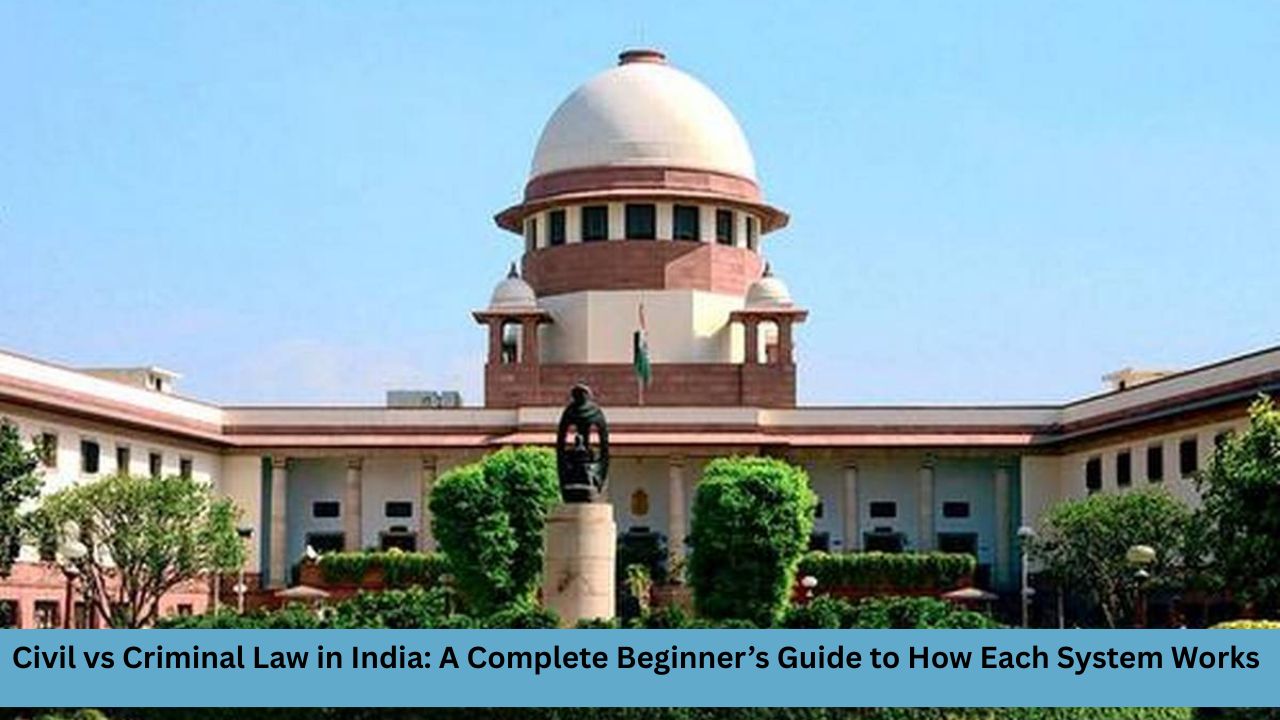
Civil law and criminal law are the two fundamental pillars of the Indian legal system, serving distinct purposes with different procedures, parties, burdens of proof, and outcomes. Understanding both systems is essential for anyone navigating legal matters in India. This guide provides a complete beginner’s overview of how civil and criminal law work, their key differences, and their roles within the country’s judicial framework.
What Is Civil Law?
Civil law primarily deals with disputes between private individuals, organizations, or entities, where one party claims that another has failed to fulfill a legal obligation, causing harm or loss. This realm of law aims to resolve conflicts, protect rights, and provide remedies such as compensation or specific performance rather than punish offenders.
Common civil cases include:
- Contract disputes
- Property and land ownership claims
- Family law matters (divorce, custody)
- Tort claims like negligence or defamation
- Consumer rights violations
In civil cases, the party initiating the legal action is called the plaintiff, while the party being sued is the defendant. The objective is generally to seek compensation or enforce certain actions, not to impose criminal penalties.
What Is Criminal Law?
Criminal law addresses offenses considered harmful to society or the state as a whole. It involves prosecuting individuals or entities accused of committing crimes, which can range from theft and assault to serious offenses such as murder and corruption.
Key criminal law features:
- The government (through a public prosecutor) files cases on behalf of society
- The accused is presumed innocent until proven guilty beyond reasonable doubt
- Punishments include imprisonment, fines, community service, or even the death penalty for grave crimes
- Focuses on maintaining public order, deterring crime, and rehabilitating offenders
Criminal offenses are codified primarily in the Indian Penal Code (IPC) and procedures are governed by the Code of Criminal Procedure (CrPC).
Key Differences Between Civil and Criminal Law
| Aspect | Civil Law | Criminal Law |
|---|---|---|
| Purpose | Resolve private disputes & obligate remedies | Punish offenders & maintain public order |
| Parties Involved | Plaintiff (private party) vs Defendant | State (Prosecutor) vs Accused |
| Subject Matter | Contract breaches, property, negligence | Crimes such as theft, assault, murder |
| Burden of Proof | Preponderance of probabilities (balance of evidence) | Beyond reasonable doubt |
| Outcome | Compensation, injunction, specific performance | Penalties: imprisonment, fines, or death |
| Standard of Guilt | Liability or no liability | Guilty or not guilty |
| Initiation | Civil suit filed by aggrieved party | Police investigation & prosecution by state |
| Court Types | Civil courts (Munsiff, District, High Court) | Criminal courts (Magistrate, Sessions, High Court) |
| Legal Representation | Private lawyer or legal aid | Public prosecutor; defense lawyer for accused |
| Remedies | Monetary damages, restraining orders | Punishments including imprisonment and fines |
How the Process Differs
Civil Law Process
- Case begins with filing a plaint (claim) by the plaintiff
- The defendant is served a summons and replies with a written statement
- Evidence is presented by both sides through documents and witnesses
- Courts focus on compensation or equitable relief
- Judgments can be appealed through hierarchical courts
Civil cases often take longer due to procedural complexities and many demand alternative dispute resolution like mediation before litigation.
Criminal Law Process
- Begins with a First Information Report (FIR) by police upon complaint or cognizance
- Investigation is conducted, and charge sheet filed if evidence exists
- Preliminary hearings decide if trial will proceed
- Trial conducted with prosecution and defense
- Conviction requires proof beyond reasonable doubt
- Sentencing follows conviction; appeals possible
Criminal cases have faster timelines for serious offenses due to the stakes involved in individual liberty.
Interplay Between Civil and Criminal Law
Some incidents can give rise to both civil liability and criminal prosecution. For example:
- A fraud can be prosecuted criminally and the victim can seek civil damages
- Assault may result in criminal charges and also civil compensation claims
However, outcomes in one do not necessarily affect the other—the standards of proof and objectives differ.
Importance of Legal Awareness
Understanding whether an issue is civil or criminal guides you on:
- Which court to approach
- The procedure to follow
- Your rights and obligations
- Types of remedies available
This knowledge helps in navigating the judicial system effectively and seeking appropriate legal help.
Conclusion
Civil and criminal law in India function as distinct yet complementary systems ensuring justice for private disputes and societal offenses. Civil law resolves conflicts between individuals with the goal of compensation or restitution. Criminal law prosecutes crimes against society with the aim of punishment and deterrence.
Knowing the differences, procedures, and protections offered under each system empowers citizens to safeguard their rights, fulfill responsibilities, and engage meaningfully with India’s legal framework.

Abhinav Jain is a legal researcher and writer passionate about simplifying complex laws for everyday readers. With a keen interest in Indian constitutional, civil, and digital laws, he focuses on creating accessible, well-researched articles that promote legal awareness among students, professionals, and citizens alike.