
By early 2026, Department of Homeland Security funding had stalled in Congress, triggering a partial shutdown that rippled through the federal security apparatus. The Transportation Security Administration, which employs roughly 50,000 screeners at airports nationwide, found itself in a particularly vulnerable position. Screeners went weeks without full paychecks, and for many, even partial payments were delayed or inconsistent.
The result was a wave of resignations and absenteeism. At major hubs such as Philadelphia, John F. Kennedy in New York, Atlanta’s Hartsfield‑Jackson, and New Orleans’ Louis Armstrong airport, reports indicated that 25 to 40 percent of assigned screeners were not reporting for duty. Checkpoints began to close, departure‑hall queues stretched into hours, and both fliers and airlines were left scrambling. The combination of the spring break travel rush and the staffing crunch turned ordinary departures into drawn‑out ordeals, with some passengers arriving three hours before flights only to stand in lines nearly as long.
Why ICE Is Being Deployed at Airports
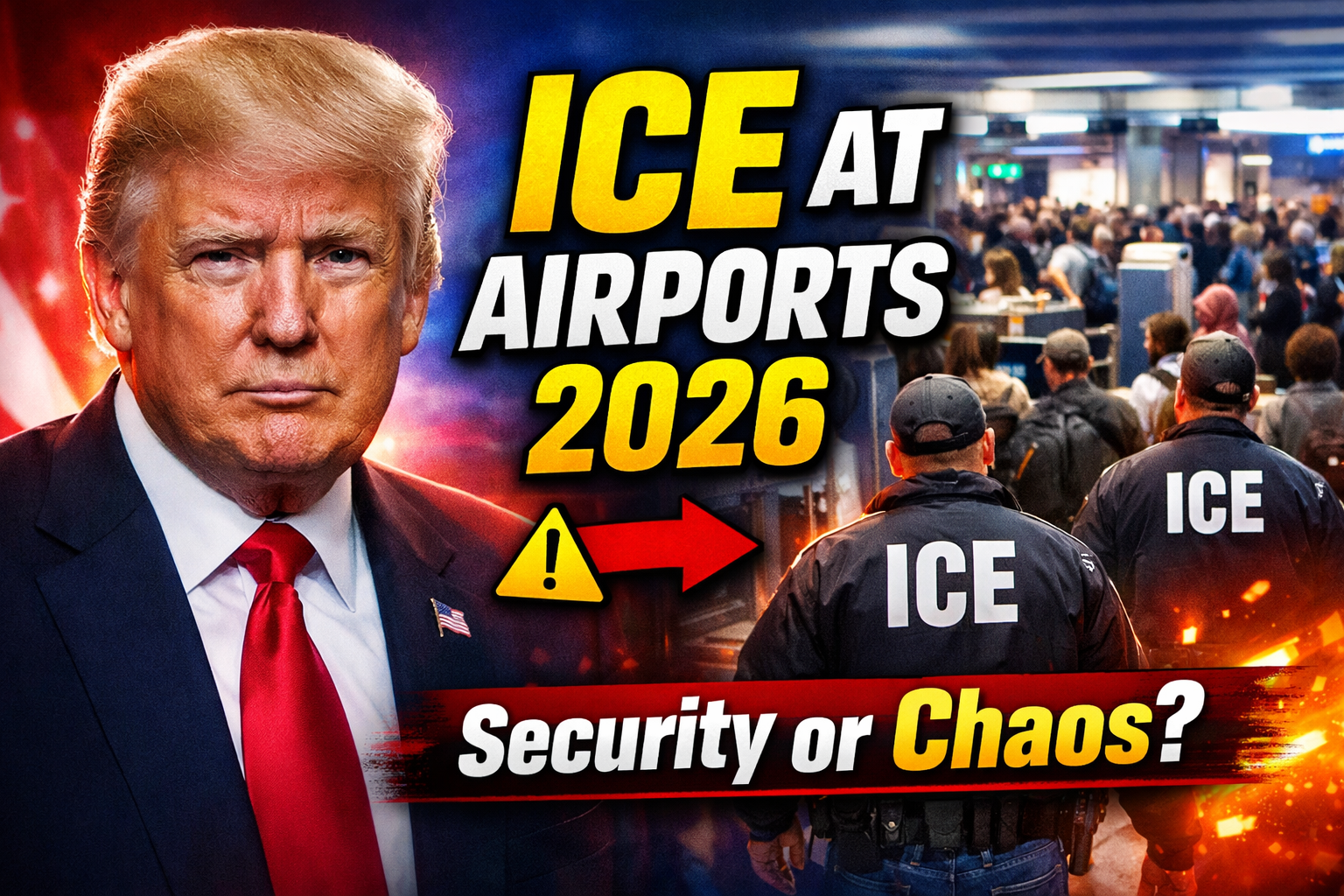
In response, the federal government announced an unconventional stopgap measure: Immigration and Customs Enforcement agents would be deployed to major airports to help manage the security‑related fallout. The president framed the move as a direct reaction to the DHS shutdown, arguing that long lines and staffing gaps threatened both safety and public confidence. The administration contended that ICE personnel, as federal law enforcement officers already familiar with airport environments, could “plug in” where possible without handling the core screening tasks performed by TSA.
ICE already operates at many airports, but its traditional role focuses on investigations around smuggling, document fraud, and immigration enforcement rather than passenger screening. In 2026, the deployment is not about replacing metal detectors or body scanners; it is about redistributing the human presence around the airport so that TSA agents can focus on high‑consequence screening while others manage crowd control, access points, and peripheral security.
How ICE Is Being Used in and Around Checkpoints
The stated plan for ICE at airports is deliberately limited in scope. Officials have emphasized that Transportation Security Officers will continue to operate the X‑ray machines, wand the passengers, and examine carry‑ons; that core function is not being outsourced. Instead, ICE agents are being directed toward tasks such as monitoring exits, guarding terminal entry and exit doors, and observing foot traffic through concourses.
At the busiest airports, ICE personnel are being placed at key chokepoints—airside exits, security checkpoints that are not actively screening, and certain access lanes—so that TSA‑assigned officers can be shifted to active screening lanes. The idea is that if an ICE agent can stand at a door that would otherwise require a TSA officer, that freed‑up screen‑line officer can move into a body‑scanner line, shortening the queue. In some cases, ICE agents may also assist with basic crowd‑control duties, such as keeping people behind the correct ropes or guiding passengers toward the correct lanes, but they are not expected to verify boarding passes in the same way that TSA agents would.
What Travelers Are Seeing On the Ground
For passengers, the most visible change in 2026 is the presence of uniformed ICE officers in parts of the terminal where they previously seldom appeared. At more than a dozen major airports, including some of the busiest hubs in the country, ICE agents are now patrolling terminals, security lines, and checkpoints. They are often seen keeping watch at exits, near security‑line entrances, or at transfer points between terminals.
In some terminals, long security lines and multiple closed lanes create a tense atmosphere. ICE officers in these areas are tasked with preventing unauthorized movement through restricted doors, which can include deterring people who might try to walk back through a security lane or use an exit as an entry point. Passengers report that while the core screening experience remains unchanged, the added law enforcement presence alters the overall feel of the airport. Some travelers describe it as reassuring, citing the sense that more trained officers are on the floor; others express unease, particularly given ICE’s association with immigration enforcement.
Civil Liberties and Legal Concerns
The deployment of ICE at airports has sparked sharp criticism from civil‑rights groups and legal advocates. Critics argue that placing immigration‑focused law enforcement officers in the heart of passenger‑screening environments blurs the line between security and immigration enforcement. They worry that travelers, especially foreign nationals and members of immigrant communities, may come to see the airport as a venue for immigration questioning rather than a routine security checkpoint.
The American Civil Liberties Union has warned that ICE agents lack the specific training and procedural focus that TSA officers receive regarding passenger‑screening protocols, privacy, and the rights of travelers. The group has also pointed to ICE’s history of controversial enforcement actions as a reason to be cautious about embedding armed immigration officers more deeply into the daily experience of air travel. Legal experts have raised questions about the extent to which ICE can be deputized to perform tasks that resemble security‑screening without clear statutory authority or new rulemaking.
Operational Limits and Practical Trade‑Offs
From an operational standpoint, the ICE deployment is designed to be a temporary patch rather than a permanent re‑engineering of airport security. The administration has repeatedly described the plan as a “work in progress,” with duties and deployment numbers still being finalized in coordination between TSA and ICE leadership. Officials have made clear that the priority is large airports where wait times regularly stretch into hours, including those with multiple security checkpoints and high‑volume terminals.
Yet there are practical limits. ICE agents are not trained to interpret scanning images, run metal detectors, or adjudicate screening exceptions. Nor are they being asked to take over the full suite of TSA responsibilities. Instead, the deployment is a narrow redistribution of labor: by having ICE cover some access points and observational roles, TSA hopes to eke out a few extra minutes of throughput per lane. In a system where every second counts, those marginal gains can translate into slightly shorter lines, but they do not solve the underlying staffing shortage.
The Political Backdrop Behind the Move
Behind the 2026 deployment lies a charged political standoff. The partial shutdown of DHS emerged from a stalemate over funding and immigration‑enforcement reforms, with Democrats and Republicans divided over the scope of border‑security measures and the size of ICE’s budget. The president has framed the funding impasse as a Democratic failure, using the long airport lines as a tangible example of what he describes as congressional inaction.
By sending ICE agents to airports, the administration is also sending a political message: that it is willing to use existing law‑enforcement resources to maintain public order even when Congress does not provide the necessary funding. Critics, including the House minority leader, have condemned the move as a misuse of ICE and a symbolic escalation of the immigration debate into the daily experience of domestic travel. Supporters argue that it is a pragmatic response to a crisis, using qualified federal officers to shore up security infrastructure that has been weakened by budgetary gridlock.
Implications for Future Airport Security Models
The 2026 ICE deployment raises questions about the future of airport security in the United States. If the current arrangement is seen as effective in managing short‑term shortages, it could open the door to more permanent or expanded use of other federal law‑enforcement agencies in airport environments. That could mean a broader redistribution of roles, where specialized agencies shoulder certain security‑adjacent functions while TSA focuses on high‑risk screening tasks.
On the other hand, the backlash from civil‑rights groups and the mixed public reaction may prompt policymakers to seek alternative solutions. These could include faster legislative action to restore full TSA funding, measures to stabilize pay and benefits for screeners, or investments in technology such as automated screening lanes and biometric verification systems that reduce the need for large numbers of human agents. Either way, the episode highlights how fragile the current security‑labor model is and how quickly it can be stressed by political and budgetary disputes.
How Passengers Can Prepare for the New Setup
For travelers navigating airports in 2026, the ICE deployment is one more layer to factor into their planning. While the core screening process remains largely unchanged, the presence of additional law‑enforcement officers means that certain areas of the terminal will feel more tightly controlled. Passengers are advised to arrive earlier than usual, especially at major hubs, and to allow extra time for security checks that may still be slow due to the underlying staffing shortage.
It is also prudent to be aware of access‑point rules. Travelers should avoid attempting to move through doors marked as exits when they are intended to be one‑way, since ICE agents may be stationed there to enforce these restrictions. Those who are concerned about immigration‑related questions in public spaces should also be prepared to carry and quickly access identification and travel documents, even though ICE is not expected to conduct systematic screenings at security checkpoints.
A Broader Look at Aviation Security Under Stress
The 2026 ICE deployment at airports is best understood as a symptom of a larger vulnerability: the dependence of a critical national security function on political stability and timely funding. When TSA screeners go unpaid, when resignations spike, and when checkpoints begin to close, the system’s fragility becomes evident. The use of ICE agents is a visible, headline‑grabbing response, but it does not address the deeper structural issues—pay, staffing levels, and long‑term workforce planning—that underpin the security‑screening apparatus.
Going forward, the episode may serve as a warning to policymakers about the risks of allowing such a heavily relied‑upon agency to operate under financial uncertainty. For the flying public, it underscores that airport security is not a static, perfectly calibrated machine, but a dynamic system shaped by politics, budgets, and the choices governments make about how to allocate resources. In that context, the 2026 ICE deployment is less a permanent change than a temporary experiment in improvisation, one that will likely be scrutinized closely the next time the country faces a similar security‑labor crisis.

Abhinav Jain is a legal researcher and writer passionate about simplifying complex laws for everyday readers. With a keen interest in Indian constitutional, civil, and digital laws, he focuses on creating accessible, well-researched articles that promote legal awareness among students, professionals, and citizens alike.