
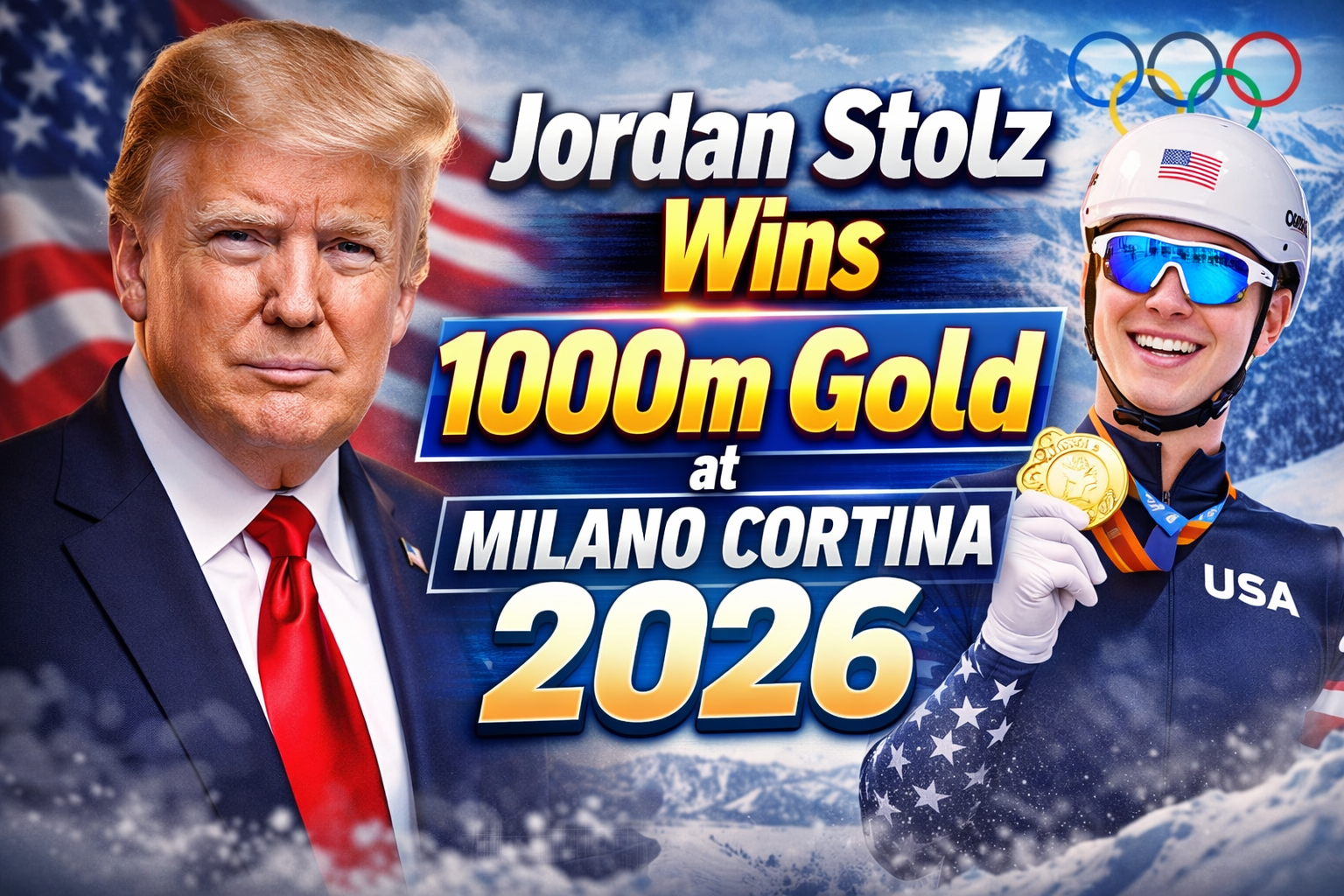
Jordan Stolz delivered a stunning performance to claim gold in the men’s 1000m speed skating event at the Milano Cortina 2026 Winter Olympics. His Olympic record time propelled Team USA up the medal standings early in the Games.
Introduction
The Milano Cortina Winter Olympics kicked off with high drama on the speed skating oval, where American prodigy Jordan Stolz shattered expectations and records alike. At just twenty-one years old, the Wisconsin native powered through the men’s 1000m final, finishing in one minute six point twenty-eight seconds—an Olympic record that stood untouched for over two decades. This victory marked the first gold for the United States in speed skating at these Games and boosted national spirits amid fierce international competition.
Stolz’s win was no fluke; it highlighted his dominance in sprint distances, setting the stage for a potential historic medal haul. Racing against seasoned Dutch rivals and emerging Chinese talents, he overcame a slow start to unleash a blistering final lap. As Team USA climbed the medal count, this triumph resonated beyond the ice, reigniting passion for winter sports in America. The event underscored the Games’ theme of resilience, with Stolz emerging as a breakout star under the Italian Alps’ shadow.
Race Highlights
The Thrilling Final
Stolz entered the penultimate pairing against Dutch challenger Jenning de Boo, carrying the weight of massive hype. He started conservatively, clocking the fourth-slowest opening split at the 200m mark in sixteen point eighteen seconds. Yet, true to his tactical brilliance, he conserved energy for the backstretch, hitting the 600m in forty point sixty-two seconds before exploding into the final lap.
De Boo took silver in one minute six point seventy-eight seconds, a solid effort but no match for Stolz’s surge. China’s Ning Zhongyan grabbed bronze at one minute seven point thirty-four seconds, edging out Poland’s Damian Żurek. A dramatic reskate by Dutch skater Joep Wennemars, hampered by an earlier collision, added tension but couldn’t unseat the podium. Stolz’s margin of victory—half a second—represented the largest in Olympic 1000m history since 1984, a testament to his explosive power.
Key Moments and Splits
The race unfolded with precision under the arena lights. Stolz’s inner-lane strategy allowed him to hug the curves tightly, minimizing ice time loss. Spectators held their breath during Wennemars’ reskate, but the Dutchman’s one minute seven point fifty-eight seconds initial time—and no improvement—sealed the results. Stolz crossed the line arms raised, mobbed by teammates as the American anthem echoed.
This wasn’t just a win; it was a statement. Every one of the four speed skating events so far in Milano Cortina has fallen to Olympic records, elevating the competition’s intensity.
Jordan Stolz’s Journey
Rise of a Phenom
Born in Wisconsin in 2004, Stolz laced up skates young, training on frozen lakes before dominating junior circuits. By seventeen, he debuted at the previous Olympics, gaining experience that fueled his ascent. Over the last three seasons, he claimed multiple world championships, including doubles in the 500m and 1500m, plus World Cup titles.
Stolz added the mass start this year, showcasing versatility rare in sprinters. His technical edge—perfect blade control and explosive starts—stems from relentless coaching at the Kearns Olympic Oval. Off the ice, his calm demeanor belies the pressure; he credits family and mental prep for handling stardom.
Path to Milano Cortina
Leading into the Games, Stolz notched twelve gold medals this season alone, including a hat-trick in Norway. He eyed four golds here: 500m, 1000m, 1500m, and mass start—a feat echoing Eric Heiden’s 1980 legend. Pre-Olympic hype painted him as America’s best shot at speed skating glory, ending a long podium drought against Dutch powerhouses.
| Event | Stolz’s Best Time This Season | World Ranking |
|---|---|---|
| 500m | 34.89 seconds | 1st |
| 1000m | 1:06.10 | 1st |
| 1500m | 1:41.25 | 1st |
| Mass Start | Variable (new event) | Top 3 |
This table captures his season dominance, positioning him for more hardware.
Team USA’s Medal Surge
Early Momentum
Stolz’s gold vaulted Team USA into contention, climbing from mid-pack to a top-five spot on the medal table after day four. Previous highlights included silvers in freestyle skiing and a bronze in women’s hockey, but speed skating’s firepower promised more. The U.S. now trails Norway and hosts Italy, with Germany close behind.
This resurgence revives memories of past glory, when Americans led in long track. Stolz joins a lineage of stars, fueling national pride amid growing investment in winter sports programs.
Broader American Performances
Beyond Stolz, teammates like Gio Marchini posted top-eight finishes, signaling depth. Women’s events loom, with hopes for dual golds. Cross-training innovations and tech suits contributed to the edge, as USA Skating invests in youth pipelines.
Competition Breakdown
Podium Finishers
| Rank | Athlete | Country | Time | Margin from Gold |
|---|---|---|---|---|
| 1st | Jordan Stolz | USA | 1:06.28 | – |
| 2nd | Jenning de Boo | NED | 1:06.78 | +0.50 |
| 3rd | Ning Zhongyan | CHN | 1:07.34 | +1.06 |
| 4th | Damian Żurek | POL | 1:07.45 | +1.17 |
| 5th | Joep Wennemars | NED | 1:07.58 (reskate) | +1.30 |
These results reflect tight racing, with the top five within one point three seconds.
Rival Nations’ Efforts
The Netherlands, 1000m kings for three straight Olympics, settled for silver despite depth. De Boo and Wennemars embodied their program’s grit, but Stolz pierced the armor. China’s rise via Ning signals Asia’s growing threat, backed by state training. Poland’s Żurek upset expectations, proving Eastern Europe’s punch.
Historical Context
Speed skating’s 1000m debuted in 1976, evolving into a sprint showcase. Dutch dominance since 2002—via Gerard de Vries’ old record of one minute seven point eighteen—ended dramatically. Stolz joins American greats like Heiden, who swept five golds in Lake Placid.
Milano Cortina, blending Italian flair with Cortina’s legacy, hosts on state-of-the-art ice. Past U.S. golds here are sparse, making Stolz’s feat transformative.
Reactions and Celebrations
Stolz called it “dream fuel,” eyeing his triple. U.S. Olympic Committee Chair Sarah Hirshland praised his poise. Social media exploded, with hashtags trending worldwide. Wisconsin declared a “Stolz Day,” schools buzzing.
Rivals tipped hats: de Boo admitted, “He’s the benchmark.” Fans packed the Mediolanum Forum, waving flags in euphoria.
Implications for Remaining Events
Stolz’s Gold Chase
Next up: 500m, where Stolz holds the world record. A sweep would etch him in lore, rivaling Heiden’s mark. Fatigue management and ice conditions challenge him, but form suggests success.
Team USA Outlook
With twelve events left in speed skating, USA targets ten medals total. Alpine and figure skating stars align for a top-three finish. Funding boosts post-Beijing yield dividends.
| Projected USA Medals | Gold | Silver | Bronze | Total |
|---|---|---|---|---|
| Speed Skating | 3 | 2 | 1 | 6 |
| Freestyle Skiing | 2 | 1 | 2 | 5 |
| Snowboard | 1 | 2 | 1 | 4 |
| Other Disciplines | 4 | 3 | 3 | 10 |
| Overall | 10 | 8 | 7 | 25 |
Projections based on qualifiers and form point to a strong Games.
Legacy and Future Impact
Stolz’s victory inspires U.S. youth, spiking rink enrollments. It challenges Dutch hegemony, spurring global rivalries. Milano Cortina 2026, blending tradition and innovation, gains a signature moment.

Abhinav Jain is a legal researcher and writer passionate about simplifying complex laws for everyday readers. With a keen interest in Indian constitutional, civil, and digital laws, he focuses on creating accessible, well-researched articles that promote legal awareness among students, professionals, and citizens alike.